Saturday, May 18, 2013
On Applause
Rouben Mamoulian's 1929 film Applause seems to have fallen through the cracks of film history. Released in a year when many of the best films still were, at least partially, silent films (GW Pabst's pair of masterpieces with Louise Brooks Pandora's Box and Diary of a Lost Girl (made in Germany), Dziga Vertov's experimental documentary The Man with a Movie Camera (the USSR), Yasujiro Ozu's Days of Youth (Japan) and Luis Buñuel's Un chien andalou (France)), Mamoulian's film is an all-talking, all-singing, all-dancing backstage musical made shot on location in New York for Paramount Pictures. Early talkies are generally derided as a step backwards in the art of motion pictures, as stiff, stage-bound and poorly acted, the camera tied in place due to the technological restrictions of primitive microphones and with that showing none of the expressiveness of the late silent era. To some extent, that is true (the talking sequences in the otherwise masterful 1928 film Lonesome are so terrible that they function less as scenes in a movie and more as meta-commentary on the pointlessness of adding dialogue to cinema), what is at question is how long it took for talking pictures to get back up to speed.
Other films from 1929 fulfill the cliche: the first Marx Brothers feature, Cocoanuts, is particularly leaden and clunky, while that year's Best Picture winner, the musical The Broadway Melody is better than its reputation, but still shockingly poorly made at times (a tap dancing sequence in which the frame cuts off the actors at the ankle so as to maintain a stage-like proscenium is particularly egregious). Ernst Lubitsch's musicals with Maurice Chevalier are some of the most charming films of the period, but his elegant classical style suffered little from the transition to sound and, from what I've seen at least, Lubitsch never seemed interested in using the camera in the dynamic ways that FW Murnau, Fritz Lang or Josef Von Sternberg (whose The Blue Angel, made in Germany a year later, shares much of Applause's mileu and attitude, but pushes the depravity that seethes under the surface to the forefront) were exploring in the late 20s. Applause offers evidence that it took far less time than is generally believed to master the technology, that the reason for the poor quality of those other films might not be the technology, but the imagination and skill of the director.
Rouben Mamoulian, making his first film, uses all the tricks of the late silent era to illuminate this standard, if resolutely pre-Code, melodrama about a burlesque dancer whose convent-raised daughter finds herself getting sucked into the degenerate family business. The mise-en-scene is Expressionist-influenced: in lighting and shadows both portentous, as in the crosses that dominate the convent sequences, and abstract, as when certain male characters become black spaces, dominating Helen Morgan's doomed showgirl Kitty; and more subtly as in the countless multiplications of Kitty's image in pictures and posters that lie in the background of many of the sets and become increasingly dominant until the film's final haunting and darkly ironic image.
Mamoulian also makes extensive use of anti-theatrical camera movement and placement: relentlessly pushing in and out of the screen space (mimicking our attraction/repulsion to the sordid and pathetic main characters); high and low angle shots including overhead views of dance sequences that abstract the characters like a proto-Busby Berkeley; de-centering the image by focusing at key moments on the characters' legs (for example during a sequence where the young woman April is being hit on by a number of men as she walks down the street) as well as abstracting bodies in a montage like the series of grotesque men's faces watching Kitty's burlesque show.
He even uses sound expressively: impressionistically like the subjective aural hallucinations Hitchcock used this same year in Blackmail (generally considered Britain's first all-talking feature) but also in overlapping dialogue and background noise to create a densely layered sonic environment, something even the best early talkies hadn't yet dared.
With Applause, Mamoulian created a fully-realized, three-dimensional cinematic world, fully integrating sound into the cutting-edge visual styles of the late 1920s. It premiered on October 7, 1929, exactly two years and one day after The Jazz Singer.
Friday, May 17, 2013
This Week in Rankings
In finally made it out to see an actual 2013 movie this week, the rather lackluster adaptation of The Great Gatsby by Baz Luhrmann. Other than that, I haven't accomplished much of anything. I did make a list over at letterboxd of all 135 movies we played over 129 weeks at Metro Classics from 2007-2011. As surveys of film history go, one could do a lot worse than trying to watch all of those movies.
Not a lot opening in Seattle this week, other than the big mess that is the Seattle International Film Festival. Ken Loach's The Angels' Share is playing in Tacoma, but I'll be making my way into the city to see Jacques Rivette's Le Pont du Nord at the Northwest Film Forum.
These are the films I watched and rewatched over the last week, and where they place on by year-by-year rankings, with links to my letterboxd reviews. Note that I'm not using the imdb date for Mama, which is incorrect.
Lonesome (Paul Fejos) - 4, 1928
The Moderns (Alan Rudolph) - 7, 1988
Mama (Zhang Yuan) - 11, 1990
Tale of Cinema (Hong Sangsoo) - 11, 2005
Chacun son cinéma (Various) - 24, 2007
607 (Liu Jiayin) - 7, 2010
The Great Gatsby - Baz Luhrmann) - 2013
Friday, May 10, 2013
This Week in Rankings
Over the last couple I've weeks I posted the second part of my series on Resident Evil and Modern Auteurism, a lengthy review of Oki's Movie, watched some Kurosawa movies in preparation for the next They Shot Pictures podcast and gave out some Endy Awards for the acclaimed movie year 1939. I also put up lists on letterboxd for Howard Hawks, Alfred Hitchcock and Hong Sangsoo.
I have a couple reviews of movies playing in theatres this week in the Seattle area, Ken Loach's The Angels' Share, Olivier Assayas's Something in the Air, and Wang Bing's Three Sisters, which is playing in New York.
These are he movies I've watched and rewatched over the last two weeks, and where they place in by year-by-year rankings, with links to my comments on them at letterboxd.
No Regrets for Our Youth (Akira Kurosawa) - 6, 1946
Drunken Angel (Akira Kurosawa) - 17, 1948
The Idiot (Akira Kurosawa) - 10, 1951
Red Beard (Akira Kurosawa) - 6, 1965
On the Occasion of Remembering the Turning Gate (Hong Sangsoo) - 11, 2002
Oki's Movie (Hong Sangsoo) - 2, 2010
Thursday, May 09, 2013
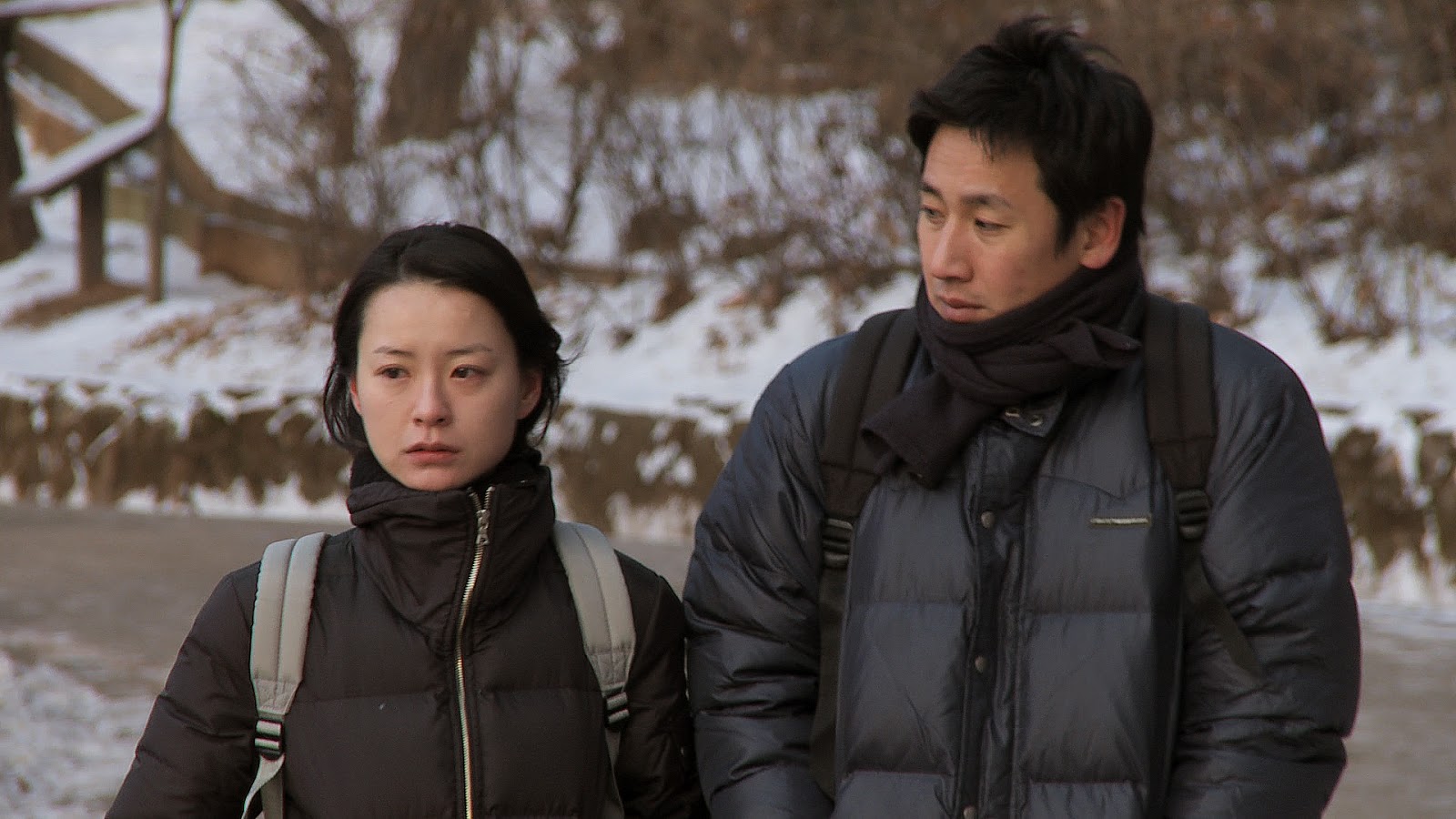
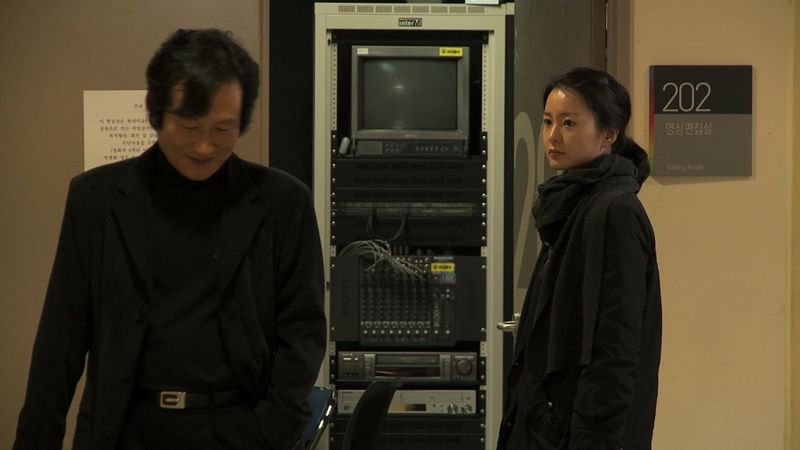
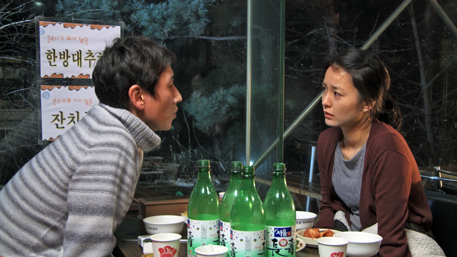
On Hong Sangsoo's Oki's Movie
I noticed yesterday that this was available as part of
Amazon’s Prime Instant Streaming service (along with Hahaha, the other Hong
Sangsoo film I saw at the Vancouver Film Festival in 2010). I watched it the other night and was happy to see that it remains my favorite of Hong’s movies, all of
which are marked by an unusual structure, in which elements, situations and/or
characters from the first part recur later in the film, in ways that deepen,
comment upon or subvert what has gone before. Oki’s Movie is the most
structurally complex of the Hong movies I’ve seen (with the possible exception of the film that followed this, 2011's The Day He Arrives), with a pretzel logic that twists
the film back on its maker, questioning the motivation for making Hong
Sangsoo films, or any films at all, in the first place.
At its most basic level, Oki’s Movie is a love triangle told
four ways, made up of four short films, each of which has its own credit
sequence of videotaped white characters on a blue background (the title song is
the same for each film: Edward Elgar’s "Pomp and Circumstance", a tune whose
relation to Graduation Day is perhaps a nod to the movies’ film school settings). The
most mysterious segment is the first one which
doesn't fit the later developed patterns or (possibly) characters at all. Its title (A Day for Incantation) suggests that it's the film that calls the other movies into being. Each
of the of the latter three films
focus on a love triangle between three characters: the girl Oki (Jung Yoo-mi),
the boy Jingu (Lee Seon-gyun) and their Professor Song (Moon Sung-keun), each
of whom are filmmakers. Each of the last three films correlates to one of their
points of view. But the characters are mixed up in the first film: Jingu is a married
film professor and filmmaker where later he will be a student, Song appears
only as a fellow professor Jingu admires but begins to have doubts about when
he hears he accepted a bribe to award another teacher tenure, and Oki doesn't
appear at all. Only at the end of the film, when an inebriated Jingu is doing an
audience Q & A prior to presenting his latest film, does the question of a
student's relationship with her teacher come up. A girl in the audience claims to have had a
friend Jingu dated when he was her professor, and that that relationship ruined the girl's life by sabotaging her relationship with her boyfriend.
My theory is that each of the subsequent films are movies
Jingu made inspired by the situation the questioner presented: a student having
an affair with her professor while she was also dating another student. In each
film, he casts himself as the boyfriend/hero and Song as the morally dubious
professor. In the second film (King of Kisses) Jingu plays the typical Hongian hero: romantic,
obsessive and often drunk. This film is the most similar to the first one in both
story and style (even the locations are the same: Jingu's home in the first film plays Oki's home in the second). One example of the rhymes between them: in each Jingu hangs
out on a park bench and falls asleep: in the second, he meets Oki and asks her
out; in the first, he has a flashback to when he met his wife, who he suspects
might now be cheating on him. (Maybe this is a flashback: wikipedia asserts that it is but the woman he meets is played by a different actress than his wife. Regardless, the story of the first Jingu's wife remains a
tantalizingly unexplored tangent, suggesting that the rest of the film could
have gone off in a myriad of other directions, not just the Song/Oki story.
Such loose ends that tease endless narrative possibilities are one of the
things that make Hong’s films seem so realistic, like they create entire
universes.) While the third and fourth films keep strictly to a single point of
view, King of Kisses is narrated more or less objectively: we also get scenes
from Oki and Song's perspectives, thus we know that they are having an affair
of which Jingu is ignorant. We also know that Oki is a little freaked out by
Jingu’s obsessive pursuit of her, but that she does genuinely like him. The
film ends happily, with Oki and Jingu together in the beginning stage of their
relationship, wishing each other a Merry Christmas and remarking on what a nice warm day it is.
The third and shortest film (After the Snowstorm) is about
Professor Song. After a blizzard, only Jingu and Oki show up for his class. The
three engage in a Godardian Q & A session wherein the kids ask him about
life and art he responds with gnomic aphorisms. It's a kind of idealized
version of the teaching experience, with two eager students lapping up Song's
wisdom (his best answer is when Oki asks why he loves his wife, he says "In life. . . Of all the important things I do, there's none I know the reason for. I don't think there is."). Later that night, after throwing up some bad octopus, Song decides to
give up teaching and go back to filmmaking ("I was a bad teacher," he cheerfully exclaims in voiceover). It's unclear if this film takes place before during or after the love triangle situation, or if one ever occurred in its world.
The fourth film (Oki's Movie) would seem to be the most
important, as it lends its title to Hong’s film as a whole. In voiceover
narration, Oki tells us this is a film about two different walks she made along
the same path in a park with two different men, one older (played by the actor
who plays Song), one younger (played by the actor who plays Jingu), two years
apart (the first, with the older man, on New Year's Eve, the second on New
Year's Day). Intercutting between the stories, she points out the similarities
and differences between the two men and her reactions to them. Pointedly, the
men are never named, we assume they are the same characters as the Songs and
Jingus we’ve seen before, because the same actors play them and they behave the
same way. But that inference is undercut by Oki’s final line: "I wanted to
see the two side by side. I chose these actors for their resemblance to the
actual people. But the limits of the resemblance may reduce the effect of the
two put together." I think she's saying that she made the film in an
attempt to sort out an experience from her past, by writing a story in which
she could see the two men she dated together and compare and contrast them, to
better understand her own experiences with them. She had an ideal of art as
catharsis, as a coming to terms with her own history. But the fact that these are
only actors means that it doesn't really help: even the greatest artist is
still only working by approximation, and without the real thing, true
understanding is impossible. Not only is the recreation never perfect, but her
perspective is necessarily limited: the best she can create is her version of her
memory of the story and the people in it.
Thus, Hong has made a film about a director who made a
series of films adopting the perspectives of each of three people involved in a
love triangle, based on a love triangle the director himself was once involved
in. And in the end, Hong, through his character the director, through his
character Oki, calls into question exactly how helpful filmmaking is as an attempt
to resolve personal issues. The motive, then, for making the movies
has to be about something more than personal revelation. Art has to go
beyond mere autobiography. The conclusion is the opposite of Alvy Singer’s in
Annie Hall, where he gives the story of his relationship with Annie the happy
ending it didn’t have in "reality" because “you're always trying to get things to
come out perfect in art because it's real difficult in life.” For Alvy, the
happy ending reassures him, brings him some kind of closure and perspective on
his relationship. Closure that eludes Oki and the first Jingu. As for Hong himself, the
answer appears to be a rejoinder to critics who presume his films, about movie
directors who drink a lot and have complicated and clumsy romantic lives, are
autobiographical. Movies aren’t real, they can't be.
This leads us back to the first film. Jingu the filmmaker/professor is meeting with one of his students, giving her advice on how to improve her film. "If you don't fix it, the narrative won't support itself. Your sincerity needs its own form. The form will take you to the truth. Telling it as it is won't get you there. That's a big mistake." She accuses him of trying to impose a formal structure on her film out of greed, to make her personal statement more palatable to a mass audience. He gets angry, the form ("two turning points!") is how the filmmaker can "take away what's fake" in her. It's not by being true to life that the filmmaker expresses the truth, but in submitting truth to formal constraints truth can be uncovered. Oki will realize that she made a mistake in trying to tell it like it was.
Director Jingu, at the Q & A at the end of the first film, expresses the hope that his film "can be similar in complexity to a living thing." Answering a question about what the themes of his film are, he continues, "Starting with a theme will make it all veer to one point. We don't appreciate films for their themes. We've just been taught that way. Teachers always ask, "What's the theme?" But before asking, aren't we already reacting to the film? It's no fun pouring all things into a funnel. That's too simple." ("But people might like simple things better," the questioner responds.)
Near the end of her film, Oki tells us that "Things
repeat themselves with differences I can't understand," which is a fitting a summation of the vision of the world expressed in Hong's filmography. A world of circular narratives that bend and repeat themselves with
variations major and minor, tied to the rhythms of everyday life in all its awkward
fumbles, missed opportunities and mysteries.
Wednesday, May 01, 2013
Army of Milla: Resident Evil and Modern Auteurism
Part Two: On the Resident Evil Movies
Part One of Army of Milla looked at Vulgar Auteurism and some issues surrounding the current discourse on low-prestige action films. Here in Part Two I'll take a general look at Paul WS Anderson's Resident Evil series, in search of evidence that Anderson might rightfully be considered an auteur.
1. History
Resident Evil
began life as a video game series produced by Capcom for the Sony PlayStation,
initially premiering in 1996 and achieving both popular and critical success.
The games are seminal in the “survival horror” genre,
a subset of the action game wherein “the player is made to feel less powerful
than in typical action games, because of limited ammunition, health, speed, or
other limitations. The player is also challenged to find items that unlock the
path to new areas, and solve puzzles at certain locations. Games make use of
strong horror themes, and the player is often challenged to navigate dark
maze-like environments, and react to unexpected attacks from enemies.” The
process of adapting the games to film began in the late 1990s, with George
Romero attached to write and direct. The producers were, however, unhappy with
the script Romero produced and brought in Paul WS Anderson who wrote an
entirely new script and signed to direct as well.
Anderson had experience with video game movies, as his 1995
film, the decent but more or less ludicrous Mortal
Kombat (an adaptation of the popular fighting game) had turned out to be a
surprise hit, despite all expectations and the presence of Talisa Soto, star of
some of the most disastrous films of the last 25 years (even her best film, License to Kill, was the movie that
nearly ended the James Bond franchise). His next couple of films (1997’s Event Horizon and 1998’s Soldier) had failed to capitalize on
that success and Anderson found himself back in the video game ghetto, barely a
step above direct-to-video land in the Hollywood prestige hierarchy. Things had
gotten so bad for Anderson that he’d had to start crediting himself with his
two middle initials to distinguish himself from the later-starting but now more
famous writer-director Paul Thomas Anderson. The first Resident Evil movie was a hit, grossing just over $100 million, and
Anderson went on to write the next four films in the series, each of which has
been poorly reviewed (they range between 21% and 34% on rotten tomatoes) and
commercially successful, with the last two films grossing over $200 million
worldwide and the series as a whole approaching $1 billion in global box office.
Anderson also directed the first, fourth and fifth films in the series, with
the second and third films directed by Alexander Witt and Russell Mulcahy,
respectively. Anderson passed on directing those to write and direct Alien Vs. Predator and Death Race. At present, Anderson is at
work on the script for the sixth Resident
Evil film, which he will also direct. Due to be released in 2014, this will
reportedly be the final film in the series.
2. Structure and Setting
The five Resident Evil
films each feature the same basic story structure. After an opening action/suspense
sequence, there’s a long bit of exposition after which the plot proper begins.
Each movie involves the main characters being trapped in a confined space from
which they must escape while evading a variety of monsters. This escape takes
up the bulk of the running time (so to speak), as the group is winnowed down to
a few survivors left to face the film’s ultimate villain in a final battle.
After the battle, there’s a short epilogue with a cliffhanger that sets up the
next film in the series. This is a classic design, especially for action films,
and you can find versions of it throughout film history, from Griffith shorts
to Indiana Jones.
Anderson has suggested that his propensity for trapping his
characters in small spaces may have something to do with his upbringing in
coal-mining country, but I wouldn’t put too much stock in such biographizing as
a general rule. Despite their confinement, Anderson often films his characters
as dwarfed by the architecture that surrounds them, trapping them in another
way within an immense space.
Each film is set in a unique environment: the first in an
underground laboratory, the second in a city at night, the third in a Western
desert, the fourth in an urban prison and the fifth in an undersea base which
itself contains multiple unique environments. More on this later.
3. Characters
The main character of the Resident Evil films is Alice, played by Milla Jovovich. She’s a new
character for the films, not appearing in any of the early video games. Alice
is the only character to appear in all of the films, and we see almost
everything through her eyes. In the first film, she’s suffering from amnesia,
but eventually we learn that she was the head of security for a secret
underground research laboratory run by the Umbrella Corporation. Umbrella is
the primary villain of the series, though it’s incarnated differently in each
film. In the first and fifth films, Alice is opposed by a homicidal computer
system, the Red Queen. In the second film, as the zombie-creating T-Virus
spreads through Raccoon City, the local military and government that has sealed
the city off hoping to contain it, condemning millions to death. In the third
film, the villain is a mad scientist, Dr. Isaacs, played by Game of Thrones’s Iain Glen. In the
fourth film, it’s Umbrella CEO Albert Wesker (played by Shawn Roberts). The
cliffhanger at the end of the fifth film has Alice joining forces with Wesker
at the White House to fight both the computer and the zombies.
Alice is aided in each film by a rotating cast, most of whom
are eaten by each film’s end. The major supporting characters include Michelle
Rodriguez as Rain (first and fifth films), Ali Larter as Claire Redfield
(third, fourth), Sienna Guillory as Jill Valentine (second, fifth), Oded Fehr
as Carlos Olivera (second, third, fifth) and Mike Epps as LJ (second, third).
The characters are fungible. Death is not necessarily the
end for them, as cloning plays a major part in the series. The fifth film is
populated with evil versions of characters that had died in earlier movies. As
well there is much genetic experimentation. At the end of the first film, Alice
is taken captive by Umbrella and injected with the T-Virus, which we learn in
the second film gives her superpowers while it turns her compatriot Matt
Addison (played by Eric Mabius) into a monster (Nemesis). While fighting Wesker
at the beginning of the fourth film, those superpowers are taken away, turning
her back into an ordinary badass action hero. He returns them at the end of the
fifth film.
This has a flattening effect on character psychology. The
films place little emphasis on backstory or motivation. We know very little
about Alice, and the supporting characters are as broad as
possible. Like the story structure, the characters are literally generic. This particularly suits Jovovich's strengths as an actress. Her appearance is vaguely alien, or at least superhuman, and her supermodelity makes her more expressive physically, with her body and with her face and eyes, than she is verbally. The films don't require her to create a character with a complex psyche, rather she's a perfect vehicle for plot delivery and audience identification (always based on fantasy).
(Not that Jovovich isn't a good actress. I was a big fan of her performance in Luc Besson's Joan of Arc movie The Messenger, though I think I might be the only one.)
4. Visual Style
There’s a bit more variation in visual style as you would
expect from a series with multiple directors but only one writer. The three
directed by Paul WS Anderson evince his clean, uncluttered approach to set
design and action editing, with a clear focus on bodies moving in space. The
fourth and fifth films especially make extensive use of slow-motion, the ‘bullet-time’
style popularized by the Matrix
films. The second film, by longtime Ridley and Tony Scott assistant director
Alexander Witt and the third, by Highlander
director Russell Mulcahy, are much more in the ‘intensive continuity’ style of
modern Hollywood action films, which uses the kinetics of rapidly cut together
shots of body fragments and empty space as a proxy for the intensity of
physical action, and thus tends to create spatially incoherent fight scenes.
The third film also uses a grainy, sepia-grey color palate similar to PWSA’s Death Race and Marc Neveldine &
Brian Taylor’s Crank: High Voltage
that looks particularly ugly next to the sleek whites and blues of Anderson’s
films.
The first film makes extensive use of security camera
footage, motivated as the POV as the Red Queen computer system. Trevor Link
makes a compelling case for this as a study of voyeurism and political power in
an
essay at his website. That thread isn’t much explored in the later films,
though the concept of the Umbrella Corporation as an entity reaching into every
aspect of our lives is somewhat there. Yau Nai-hoi’s Eye in the Sky from 2007, produced by Johnnie To, is I think more
successful and nuanced at analyzing surveillance culture through use of
different film stocks representing the various ways we are spied on in public.
5. Referentiality
The Resident Evil
films, with their schematic plot structures and generic characters are the
perfect vehicles for movie references. The structure allows the films to be set
in almost any kind of environment, and Anderson utilizes them to essentially
chronicle the last 50 years or so of action and suspense cinema. The references
begin with the first shot (repeated in each of the first three films), an
extreme close-up of Milla Jovovich’s eyeball, from which the camera slowly
pulls away reveling her collapsed body in a bathtub, shower curtain draped
around her. It’s the inverse of one of the concluding shots from the shower
scene in Alfred Hitchcock’s Psycho.
Where that camera spirals into Janet Leigh’s dead eye, Anderson spirals out.
What we’ll get is a story of life after death: literally as the dead come back
to life but also life after the death of civilization, the twisted clone lives
of the dead side characters, and the indestructibility of Alice herself, never
more evident than in the beginning of the fourth film, when she storms Umbrella
Headquarters backed by an army of Alice-clones. We see Alice die again and
again and again.
Each film in the series has a specific model from genre film
history. The first is a variation on Alien,
with a small group of people trapped in a confined space against an enemy they
don’t understand being manipulated by a shadowy corporation and a computer that
doesn’t place much value on human life. The second film recalls Escape from New York, where Alice and
her companions must traverse an overrun and locked-down metropolis to rescue
someone (in this case the daughter of an Umbrella scientist as opposed to the
President in John Carpenter’s film). There are also hints of George Romero’s Land of the Dead, with the city walled
off from the zombie hordes while the elites escape. The third film takes place
after the virus has spread, destroying civilization and much of the planet
itself. It’s a desert world where fuel is the most important currency and gangs
of survivors attempt to caravan to a promised land. In other words: it’s The Road Warrior. The fourth film begins
with the attack of the Alice-clones, shot in a cleanly digital bullet-time with
the Alices dressed in the all-black cat-suit Carrie-Anne Moss sports in The Matrix. The film’s middle section
takes place in a prison where a group of survivors is surrounded by zombies,
recalling Carpenter’s Assault on Precinct
13. The fifth film presents the most complex set of references: it’s based
on the Resident Evil series itself,
going about as far as sustainable down its own rabbit-hole.
Opening with a gorgeous action sequence played in slow
motion and backwards as the credits role, then replayed forwards, the film quickly
plunges Alice into a massive undersea Umbrella base. Within that base are the
aforementioned clones of the characters from previous films, as well as a
series of unique environments: the Raccoon City of the first film, a sequence
set in Tokyo (replayed and expanded from the fourth film), and the ultra-white
Umbrella hallways seen in most of the other films. Unique to this film is a
normal suburban world, complete with an Alice clone who thinks she’s a typical
housewife with husband (a Carlos clone) and daughter. This world is then
ravaged by zombies in an experiment run by the Red Queen. This is the only time
we ever get to see Alice leading anything like a normal life. The plot of the
film more or less follows that of Aliens,
with Alice joined by a team of soldiers to rescue a little girl, her clone
child from the suburban simulation. It ends with a confrontation straight out
of Ice Station Zebra, with each side
facing off in an Arctic wilderness: Alice and the surviving soldiers vs. a now
super-powered and evil Michelle Rodriguez clone and a brainwashed Jill
Valentine.
Watching most of Paul WS Anderson’s films, this kind of
referentiality is what strikes me as his most distinctive trait. Almost all of
his films are based on an existing, and very popular, property of some kind: Death Race is a straight remake of the
70s cult classic Death Race 2000, The Three Musketeers is a reasonably
faithful adaptation of the Dumas novel, albeit with a wildly anachronistic
twist, Alien Vs. Predator is a movie
based on a game based on two series of movies. The latter I think gives a clue
as to Anderson’s approach to genre and story, as the mythologies of these sci-fi
classics are melded with actual historical mythology and some contemporary
conspiracy theories about ancient history. The film posits that the pyramids
built in Egypt and Central America were built by aliens, and that humanity
participated in ceremonial sacrifices there. These aliens were the Predators
and the sacrifices involved the Aliens. There’s a seamlessness to the way
Anderson passes from one mythology to the other, with the way he adapts and
bends previously created material to build his own unique mythological world.
It’s somewhat akin to the way a backwoods preacher has a limitless supply of
bible verses at his disposal for use in any situation. Except for Anderson, the
bible is genre cinema.
The question remains though, is there enough evidence to call
Paul WS Anderson an auteur? He has a unique approach to story and character,
with a distinctive visual style and appears to be exploring interesting and
personal thematic territory. But is it art? I’ll attempt to answer that in the
next and final installment of this series, Resident Evil and Classical Auteurism.
Monday, April 29, 2013
1939 Endy Awards
It's been a few months, so it feels like time to hand out some more awards. 1939 is generally considered one of the greatest film years ever. The Hollywood studio system was at its peak and the French, British, Soviet, Italian and Japanese film industries were yet to be entirely devastated by war. I don't know that it's my favorite year, 1932 and 1937 might even be the best years of the 1930s. I do think that eventually 2012 will be remembered among the great years in movie history.
Here are my fake awards for 1939. In the Endy Awards Index you can find entries for 2011, 1932, 1964, 1957 and 1994, as well as posts for the awards I made several years ago. Eligibility is determined by imdb date and by whether or not I've seen the movie in question. Nominees are listed in alphabetical order and the winners are bolded. And the Endy goes to. . .
Best Picture:
1. Mr. Smith Goes to Washington
2. Only Angels Have Wings
3. The Rules of the Game
4. Stagecoach
5. Young Mr. Lincoln
Best Director:
1. John Ford, Stagecoach
2. Howard Hawks, Only Angels Have Wings
3. Kenji Mizoguchi, The Story of the Last Chrysanthemums
4. Jean Renoir, The Rules of the Game
5. John Ford, Young mr. Lincoln
I don't think that any director has ever had a better year than John Ford did in 1939, but Renoir made of the very best films of all-time this year.
5. John Ford, Young mr. Lincoln
I don't think that any director has ever had a better year than John Ford did in 1939, but Renoir made of the very best films of all-time this year.
Best Actor:
1. Clark Gable, Gone with the Wind
2. Robert Donat, Goodbye Mr. Chips
3. James Stewart, Mr. Smith Goes to Washington
4. Cary Grant, Only Angels Have Wings
5. Henry Fonda, Young Mr. Lincoln
My favorite performance from my pick as the greatest actor in movie history gets the win here, against a very strong field. Donat won the Oscar, with Stewart getting the make-up prize the next year for The Philadelphia Story. His co-star in that film, Cary Grant, would probably be my pick that year instead, on the strength of His Girl Friday. Although, Stewart was also in my favorite film from 1940, The Shop Around the Corner. We'll see what happens when I get around to giving out those awards.
Best Actress:
Supporting Actor:
1. Harry Carey, Mr. Smith Goes to Washington
2. Marcel Dalio, The Rules of the Game
3. Jean Renoir, The Rules of the Game
4. Thomas Mitchell, Stagecoach
5. John Wayne, Stagecoach
If John Ford had the best director year ever in 1939, Thomas Mitchell may have had the best year for a supporting actor. Standout performances in five great movies (Stagecoach, Only Angels Have Wings, Mr. Smith Goes to Washington, Gone with the Wind & The Hunchback of Notre Dame)? Can anyone top that? Tough to leave out Claude Rains in Mr. Smith and Humphrey Bogart in The Roaring Twenties here. I suspect they'll be getting some Endy-love in the 1940s.
Supporting Actress:
1. Jean Arthur, Only Angels Have Wings
2. Olivia DeHaviland, Gone with the Wind
3. Marjorie Main, The Women
4. Maureen O'Hara, The Hunchback of Notre Dame
5. Maria Ouspenskaya, Love Affair
Original Screenplay:
1. Jacques Viot & Jacques Prévert, Le jour se lève
2. Charles Brackett & Billy Wilder, Midnight
3. Sidney Buchman, Mr. Smith Goes to Washington
4. Jean Renoir & Carl Koch, The Rules of the Game
5. Lamar Trotti, Young Mr. Lincoln
Adapted Screenplay:
1. Joel Sayre & Fred Guiol, Gunga Din
2. Charles Brackett, Billy Wilder & Walter Reisch, Ninotchka
3. Jules Furthman, Only Angels Have Wings
4. Dudley Nichols, Stagecoach
5. Matsutarô Kawaguchi & Yoshikata Yoda, The Story of the Last Chrysanthemums
Impressive for Brackett & Wilder getting nominated in both screenplay categories. They didn't win (tough to beat out two of the most perfect screenplays in film history), but I except we'll be seeing more of these guys.
Non-English Language Film:
1. The Rules of the Game
2. The Story of the Last Chrysanthemums
3. Le jour se lève
Unseen Film:
1. Each Dawn I Die (William Keighley)
2. Sincerity (Mikio Naruse)
3. The Spy in Black (Michael Powell)
4. St. Louis Blues (Raoul Walsh)
5. Union Pacific (Cecil B. DeMille)
I'm actually surprised there aren't more of these, especially with my having seen only three non-English language films. But looking through imdb's database, these were the best I could come up with. There's another Naruse from this year, but Sincerity sounded better.
Film Editing:
1. Only Angels Have Wings
2. The Roaring Twenties
3. The Rules of the Game
4. Stagecoach
5. The Wizard of Oz
Cinematography:
1. Ernest Haller, Gone with the Wind
2. Philippe Agostini, André Bac & Albert Viguier, Le jour se lève
3. Jean-Paul Alphen, Jean Bachelet, Jacques Lemare & Alain Renoir, The Rules of the Game
4. Bert Glennon, Stagecoach
5. Yozô Fuji & Shigeto Miki, The Story of the Last Chrysanthemums
Original Score:
1. Gone with the Wind
3. Le jour se lève
5. The Story of the Last Chrysanthemums
2. The Wizard of Oz
4. Young Mr. Lincoln
Adapted Score:
1. Babes in Arms
2. The Rules of the Game
3. Stagecoach
Original Song:
1. "Ding Dong the Witch is Dead", The Wizard of Oz
2. "Good Morning", Babes in Arms
3. "If I Only Had a Brain", The Wizard of Oz
4. "Somewhere Over the Rainbow", The Wizard of Oz
5. "We're Off to See the Wizard", The Wizard of Oz
These soundtrack awards are pretty much no-brainers. Or if I only had a brainers.
2. "Good Morning", Babes in Arms
3. "If I Only Had a Brain", The Wizard of Oz
4. "Somewhere Over the Rainbow", The Wizard of Oz
5. "We're Off to See the Wizard", The Wizard of Oz
These soundtrack awards are pretty much no-brainers. Or if I only had a brainers.
Art Direction:
1. Drums Along the Mohawk
2. Gone with the Wind
3. The Hunchback of Notre Dame
4. The Rules of the Game5. The Wizard of Oz
Costume Design:
1. Gone with the Wind
2. The Private Lives of Elizabeth and Essex
3. The Rules of the Game
4. The Wizard of Oz
5. Young Mr. Lincoln
2. The Private Lives of Elizabeth and Essex
3. The Rules of the Game
4. The Wizard of Oz
5. Young Mr. Lincoln
Make-up:
1. Goodbye, Mr. Chips
2. The Hunchback of Notre Dame
3. The Private Lives of Elizabeth and Essex
4. The Wizard of Oz
5. Young Mr. Lincoln
2. The Hunchback of Notre Dame
3. The Private Lives of Elizabeth and Essex
4. The Wizard of Oz
5. Young Mr. Lincoln
Sound Mixing:
1. Gone with the Wind
2. Gunga Din
3. Only Angels Have Wings
4. Stagecoach
5. The Wizard of Oz
2. Gunga Din
3. Only Angels Have Wings
4. Stagecoach
5. The Wizard of Oz
Sound Editing:
1. Beau Geste
2. Gone With the Wind
3. Gunga Din
4. Only Angels Have Wings
5. Stagecoach
3. Gunga Din
4. Only Angels Have Wings
5. Stagecoach
Visual Effects:
Subscribe to:
Posts (Atom)