Friday, October 08, 2010

VIFF '10: Day Five


The Sleeping Beauty - A kind of companion piece to the wife's favorite film from last year's festival, Blue Beard, Catherine Brelliat again adapts a Charles Perrault fairy tale, giving it a distinctively modern kink.  Unlike last year's film, which had a framing story in which two girls read the fairy tale that provided both the best and worst parts of the film, this one plays the tale straight through.  The difference from the familiar Disney version of the story is mainly that instead of falling asleep at 16 and waking 100 years later, the good fairies (who are also much hotter in this version) fix things such that the princess falls asleep at age 6 and wakes up 100 years later at 16, having experienced a wild dream adventure in the interim.  This dream takes up the bulk of the film, as the princess embarks on a quirky quest (a boil-covered ogre, a handsome pubescent prince, a snow queen, a lesbian gypsy queen and a few, but less than seven, dwarfs).  When she wakes up, she meets her prince and learns that the fantasies we have in childhood don't quite work out the way we thought they would.  It's not an especially profound message, but it's a fun ride getting us there.


Rumination - Part of the new filmmakers competition this year is this story of the Cultural Revolution, split into ten sections, one for each year from 1966-1976.  The early years move by pretty quickly, as a group of young Red Guards talk about how great Mao is and what have you.  In later years they attempt to march to Beijing, but end up apparently living in a seemingly abandoned town where they torment both the local crazy homeless guy and their own boss, who demonstrates a counter-revolutionary attraction to a picture of a Hollywood starlet (couldn't tell if it was Joan Fontaine or Ingrid Bergman or someone else entirely, regardless that makes it certainly not a revolution I'd ever want to be part of).  The film has some striking imagery, notably repeated sequences in a kind of confessional, where people recite odes to Mao and the proletariat and that change color with the years.  These sequences have the kind of artificial frontally of Sergei Parajanov's The Color of Pomegranates.  Most of the film though, with its almost total lack of character, plot or dialogue can be extremely frustrating.  It tries so hard to keep the audience at a distance that all it really ends up saying is "hey, the Cultural Revolution sure sucked!"  Which is certainly true, but don't we already know that?


Uncle Boonmee Who Can Recall His Past Lives - Apichatpong Weerasethakul's Palme D'Or winner from this year is probably his most conventional film yet, though you can be sure it's plenty weird enough.  Boonmee's dying of kidney disease and his sister-in-law and nephew come to visit him.  Arriving shortly thereafter are the ghost of his dead wife and their Sasquatchian son, who disappeared years before when he married a Monkey Ghost and became one himself ("Son, why have you let your hair grow so long?" is the ghost mom's deadpan question).  Boonmee tries to prepare himself and his family for his impending death, which leads to some creepy spelunking (a sequence reminiscent of Picnic at Hanging Rock as well as, musically if nothing else, Kubrick).  Somewhere in there as well as a period story about an ugly princess and her memorable encounter with a catfish that may be one of the past lives of the title.  Most of Weerasethakul's films have a dual structure, and there's a narrative split here as well, but it's more of a coda than a second half.  Like both Tropical Malady and Syndromes and a Century, but even more like Thomas Mao, which we saw a couple days earlier here at VIFF, the second part both undermines and expands the world of the first half, making us question everything that came before in a warmly constructive, humanist way (as opposed to the aggressively cynical deconstruction of many other puzzle films).  It's ultimately not as mysterious or audacious as Tropical Malady, but it might be his best film yet.

Wednesday, October 06, 2010

VIFF '10: Day Four


607 - Before getting to Day Four's films, I wanted to mention this short by Liu Jiayin that played before Day Three's showing of Thomas Mao.  Liu made my favorite film from last year's festival, Oxhide II, which also happens to be the highest rated film directed by a woman on my recent Top 600 Films of All-Time list.  This 17 minute short consists mostly of one shot of a bathtub in a hotel room (the hotel apparently commissioned the film).  A plastic fish, manipulated by Liu's father, with only his hands visible, swims in the water and encounters some mushrooms, a cloudy sky and a fish hook.  The mushrooms are played by Liu's mother and Liu herself is the sky and hook.  It's a marvelous bit of silliness that conveys all the warmth of a family at play.


Hahaha - The first of two films directed by Hong Sangsoo at this year's festival, it begins, unsurprisingly for Hong, with two old friends drinking and telling stories about women.  The film proper is comprised of these two stories, which end up being about the same woman, though neither knows it, while the frame is played in black and white stills with voiceover (and lots of "Cheers!" as the two drink quite a lot).  The Hong films I've seen all have a split structure, with the second half of the film telling a new story with some of the same characters in a way that mirrors and comments upon the events of the first story.  This film has that same structure, but the stories are intercut instead of segregated.  This makes the film a lot easier to watch, and this is definitely the film I'd recommend to anyone who hasn't seen a Hong Sangsoo film yet.  As for the stories themselves, they're Hong's traditional terrain of romantic misadventures and misunderstandings and lots and lots of drinking.  Again there's a character who's a film director, this time he falls for a tour guide who's dating a poet who's best friends with a guy who's on vacation from his wife with his girlfriend.  It's this last guy and the director who are the two narrators of the film.  It's as funny as Like You Know It All, one of my favorites at last year's festival, if not quite as weird and certainly not as insidery about film festival life.


The Fourth Portrait - This Taiwanese film is about a precocious young boy named Xiang who's father dies, sending him first into the helpful hand's of the school janitor, and then back to his mom, a prostitute (naturally) and step-father (who's pretty much pure evil).  Director Chung Mong-hong keeps this dire material much lighter than one would expect.  Though the kid's situation is rough and potentially terrifying, there's enough humor and visual style (there's traces of both the Taiwanese New Wave (Hou, Yang and Tsai specifically) but also Wong Kar-wai, the latter especially in the scnes at the mom's "lounge") that things never get as horribly depressing as they might in a lesser film.  There's even a musical bit that sounds like a Chinese version of the Carl Orff song used in Badlands and True Romance) Xiang is surrounded by helpful adults, from the elderly janitor to a small time hustler to a concerned teacher.  Even his mom is a decent sort.  We never get the sense that Xiang's situation is hopeless, instead, we can be sure that he'll survive and thrive.  The title comes from a series of drawing's Xiang makes throughout the film: the first is his father, the second his friend the hustler, the third his older brother who may be haunting him and the fourth, more than a little cheesily, is the film itself.


I Wish I Knew - After last year's excellent 24 City, I wasn't quite prepared for this latest film from Jia Zhangke.  While that film was a documentary that mixed scripted and acted interviews with real-life talking heads in a way that made one question the nature of documentary realism, this film is pretty much a straight and conventional film.  It's an epic collection of stories about Shanghai, told by the people who lived there and the children of the people who lived there.  Shanghai was the epicenter for the most important developments in China over the 20th Century, from the British to the Japanese Invasion to the Civil War between the Communists and Chaing Kai-Shek's KMT to the Cultural Revolution to the embrace of capitalism in the late 1980s.  Even the Chinese film industry was based there for much of the century.  Jia's 18 interviews tell these stories in detail, with communists and KMT generals and movie stars and directors.  Wei Wei appears, which marks two days in a row that we saw a film featuring this 88 year old actress, after The Drunkard.  Also interviewed are Hou Hsiao-hsein (who's actually the only person who doesn't share a personal anecdote, he just talks about his film Flowers of Shanghai, though like many people in the film, his parents came to Taiwan from Shanghai ahead of the Communist victory).  The film is very loosely structured, with the interviews coming not in chronological order of their stories, but rather the geographical order of where they have spread out.  The Shanghai diaspora mainly went to Taiwan and Hong Kong, and so Jia goes to each of those places to seek out their stories.  But these interviews are interspersed with scenes of present-day Shanghai, where frequent Jia star Zhao Tao wanders mutely around the sites of the old stories, neatly tying the old and new, the diasporic and the homeland together.  It's a beautiful film, about as good as a straight documentary can be.


Short Celebrity Addendum: Jia was there last night for a Q & A (he's serving on the jury at the festival this year for the award for new Asian filmmakers that they've given out for 17 years or so, having previously won the award for his own first film Xiao Wu).  I don't know that I've ever been so giddy in a movie theatre.  And then this morning, waiting in line for Catherine Breillat's Sleeping Beauty, I'm pretty sure we were standing behind a very confused Wallace Shawn (the screening was delayed for projection reasons and the staff were giving confusing directions to the old people).  I attempted to help the maybe-Shawn through the line, but he either couldn't hear me or was too confused to pay attention to a much taller man.

Tuesday, October 05, 2010

VIFF '10: Day Three


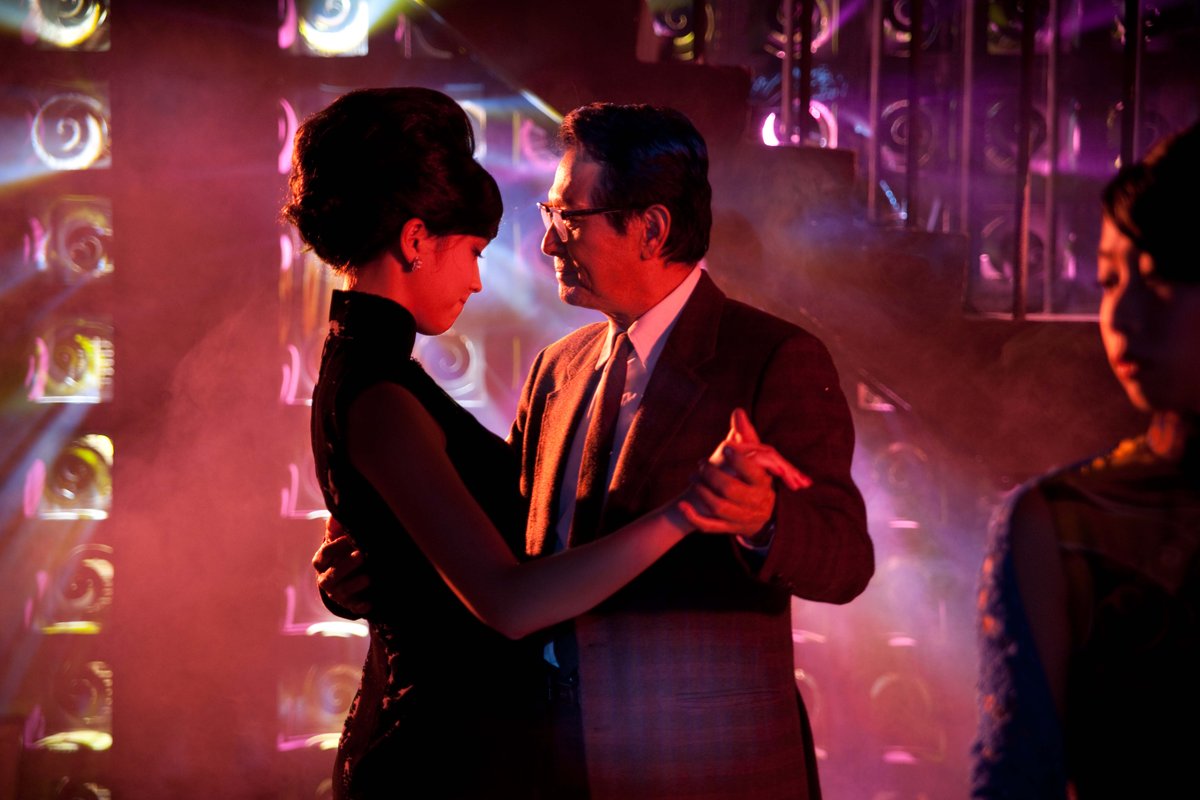
The Drunkard - Freddie Wong's debut film is an adaptation of one of the most famous modern Chinese novels, written by Liu Yichang.  In early 60s Hong Kong, a struggling writer juggles his declining career prospects (he goes from Hemingway ambitions through martial arts novels and screenplays to pornography), various women (a landlord's 17 year old daughter, a couple of prostitutes, old and young, an elderly landlady played by Wei Wei, the star of the 1948 classic Spring in a Small Town) and copious amounts of alcohol.  Wong Kar-wai's In the Mood for Love and 2046 are somewhat based on similar characters, though his films are so infused with his own obsessions that it'd be a stretch to call them adaptations.  That the film was made for a mere $500,000 is remarkable, though it does explain the intimacy of the cinematography: almost always medium to close shots of small interiors.  The nightclub scenes have the Christmas tree red glow you'd expect, but there's nothing glamorous about the writer's alcoholism.  Neither is it ever reduced to any kind of social problem picture preachiness: he drinks and he writes, but not necessarily in that order.  John Chang (the father of Chang Chen, star of Crouching Tiger, Hidden Dragon) is terrific in the lead role, nowhere near as debonair as Tony Leung in the Wong films, he brings a weary reality to every scene.


Thomas Mao - Inspired by the unusual friendship between his friends Mao Yan and Thomas Rohdewald (Mao is a famous oil painter who has used Thomas as a subject dozens of times, the paintings, which appear at the end of the film, are very interesting and very creepy) Zhu Wen's film is a whimsical exploration of what Mao and Thomas might have been like had they met in other lives.  In the main story, Thomas is a traveling painter who spends a few days at Mao's inn.  Thomas doesn't speak Chinese and Mao doesn't speak English, and the two find various funny ways of miscommunicating.  Appearing to each of them are also what appear to be ghosts of medieval warriors, a woman in black and a man in white.  There's a stunningly choreographed fight/dance sequence between these two, that's the visual highlight of a very beautiful film.  Eventually, there's aliens and some snow.  But the most surprising part of the film is a coda set in an art gallery, where Thomas and Mao hang out and various elements from the main story recur in unexpected ways.  It works like a funhouse mirror, folding the narrative back on itself.


Crossing the Mountain - Vancouver may not have gotten Jean-Luc Godard's Film Socialisme, but we're not wholly bereft of intentionally partially-subtitled avant-grade narrative films.  Yang Rui's opaque film, photographed in sharply focused, long-take HD, is set in Yunnan, along the Burmese border, the people here speak a local language, and she has chosen to only subtitle the "important" parts of the dialogue, even for the Chinese-speaking audience.  Mostly a set of discrete, seemingly plotless episodes that are nonetheless pregnant with possibly meaningful images and juxtapositions, with more or less the same set of characters for most of the film who inexplicably disappear in the later sections (though we may have some clues at to their fate).  It might be about the dangers of unexploded ordinance in Southeast Asia (still a problem, even in areas where the wars have been over for 30 years), but more than that it's about living in a collision between past and present.  The film is set in land that once belonged to a people that until quite recently practiced human sacrifice as agricultural aid (where these people are now, we can't say, but assume they have merged with the general population), where kids try to watch TV and play karaoke video games (though the technology never seems to work properly) and old people pass the time with folk dances that look not unlike the Hokey-Pokey.  Basically, it's an impossible film to describe, and apparently quite difficult to sit through.  Despite a warning from programmer Shelly Kraicer about the film's difficulty and the need for patience with it, about the third of the audience walked out.  I was glad to stay through the end.  While it wasn't the best thing I've seen at the festival thus far, I certainly haven't seen anything quite like it.

Monday, October 04, 2010

VIFF '10: Day Two


Of Love and Other Demons - An adaptation of a Gabriel García Márquez story that I haven't read, Hilda Hidalgo's first film is about a teenaged girl in 19th Century Cartagena, the daughter of a Marquis, who gets bit by a rabid dog.  Despite the Marquis' disbelief, he is unable to prevent the local Catholic authorities from imprisoning her under suspicion of demonic possession (apparently the Devil works through rabies).  The priest assigned to examine her of course falls in love with her (she's not a stunning beauty, but has a fabulous head of red hair, three feet long and shockingly clean for the 18th century) to the detriment of his ecclesiastical career.  More straightforward than I would expect from García Márquez, the film is essentially an ecofeminist parable about the evils of patriarchy, imperialism and the Church and its destructive effects on the environment (the girl is frequently seen communing with insects, and one of the reasons she's suspected of being possessed is that she can speak the African languages of her family's servants).  It does leave open the much more interesting possibility that the girl actually is possessed, with the devil using her to wreak havoc with the nobility and Catholic hierarchy in the later stages of the Spanish Empire.


Get Out of the Car/The Indian Boundary Line - A pair of shortish features, both exploring hidden elements in everyday geography.  Thomas Comerford's The Indian Boundary Line is about a treaty line  running through what is now Chicago.  The line was supposed to establish the Northwestern limit of American expansion, leaving much of Western Illinois and Southeastern Wisconsin for the Indians.  The film is split into separate sections, each showing a part of the line as it is now (three parks, an intersection, a normal urban street) with accompanying voiceover (personal reminiscences, treaty language, bits of Little House on the Prairie).  For the most part it's pretty interesting, though there's a central section where the voiceover is a list of GPS coordinates that goes on interminably.  More fun is Thom Anderson's Get Out of the Car, a tour of visual oddities in Los Angeles, with a particular focus on out of use billboards and giant murals of Jesus and the Virgin Mary.  The soundtrack is mostly older recordings that were made in LA, though occasionally we hear what appear to be passersby heckling Anderson as he films, which can be pretty funny.  Where The Indian Boundary Line shows the history that surrounds our everyday world, Get Out of the Car tries to highlight the beauty in the urban decay and ugliness we walk past every day.  I haven't yet had the chance to see Anderson's acclaimed Los Angeles Play Itself, but this only makes me want to that much more.


Poetry - This is the first Lee Changdong film I've seen, and I'm kind of mixed in my response to it.  On the one hand, it's a wonderful character study of a 66 year old woman, raising her grandson and working part-time as the caretaker for an elderly man who takes a poetry class on a whim and struggles to find poetic inspiration in the world around her.  On the other hand, it's the story of a grandmother who learns that her son is part of a group of kids who gang-raped a classmate until she killed herself, and is being pressured by the other boys father's to come up with hush money for the girl's parents.  I really like that first movie, the second seem unnecessarily exploitive, as if Lee thought audiences wouldn't be interested enough in the grandmother's story if there wasn't some horribly hyperbolical sexual violence mixed in somewhere.  The unreality of that part of the film (not just in its setup but also its coincidence-driven plot mechanics) doesn't necessarily undermine the rest of the film, but it is fairly distasteful.  The performance by Yun Junghee as the old woman is magnificent.


Icarus Under the Sun - A very low-budget film made by two Japanese women (one wrote and directed and stars, the other shot, directed and plays a supporting role) that's a grungy, realist account of a young woman trying to find her way in Tokyo.  She gets a job at a mahjong parlor and befriends the eccentrics who work and hang out there: the blind ex-thief owner, the slightly crippled boy named after Alain Delon, the crazy woman who loves the blind owner, etc.  Of all the young adult coming of age films we've seen at the several festivals we've been to, this is bar far the most serious and probably also the most DIY.  The dreariness of the girl's life (always in darkness, the various characters dislike of sunshine is a key motif) is almost oppressive.  In the end, she manages to escape into the daytime, but I don't know that the catharsis is enough to compensate for the misery of the first 75 minutes of the film.  I needed some air.

Sunday, October 03, 2010

VIFF '10: Day One


We're back at the Vancouver Film festival for the third year in a year and unlike the 08 and 09 festivals I'm going to not only try and write about the films we see before six months have passed, but day by day as we watch them. We'll see how it goes. Anyway, we arrived in town this afternoon and made it to two films tonight.

Made in Dagenham - Sally Hawkins is already getting some Oscar buzz for her performance in this crowd-pleasing dramatization of a strike at a Ford plant in the UK in 1968.  The workers are the 187 women (out of 55,000 in the country) who sew the interiors of the cars together, and are classed as unskilled labor and make far less than comparable male workers.  The strike quickly becomes about equal pay for equal work, annoying every man in the country (except Bob Hoskins, ho helps the striking women out).  Hawkins is excellent as the leader of the strike, she manages to be both shy and fiery at the same time (and she deserved the Oscar a couple years ago for Happy-Go-Lucky, so even if this performance isn't as singular as that one, I wouldn't begrudge her any hardware she gets for it).   Miranda Richardson does a lot of funny yelling as the government minister who follows the strike from a distance, and Richard Schiff (from The West Wing) is appropriately menacing as Ford's American representative.  Rosamund Pike, as the wife of one of the Ford execs his is nonetheless sympathetic to the cause gets the best speech in a film chock full of speeches, when she explains to Hawkins who her advanced degree from Cambridge somehow doesn't keep her husband from treating her like she's an idiot.  Cinematically, the film isn't much to look at.  The draw here are the big performances and lefty reassurances.


My Film and My Story - At the opposite end of the budget and profile level is this student group project from Korea.  Seven different kids at Konkuk University each directed one segment of this film about workers at a single-screen movie theatre on campus.  The theatre is in the final stages of renovation before reopening (assuming they can win the support of the government), and the newly hired staff and strange customers have a series of mostly comical adventures.  Two guys watch Happy Together and start to question their sexuality, a girl vehemently rebuffs the advances of a kid who talks about Lacan, another girl collects ticket stubs and nitpicks the temperature, but sleeps through the film and so on.  It all looks quite polished (with only one sequence standing out narratively and visually from the whole, its placement at the film's midpoint is certainly intentional), though the sound is a little rough at times.  Best of all the sequences is one involving the manager of the theatre as she talks to her bartender about the cinema and why she loves it.  It's not as ambitious as Tsai Ming-liang's Goodbye, Dragon Inn, but it is more grounded in reality and the day-to-day life of the people who actually work in theatres, which doesn't make for a transcendent film-going experience, but certainly a pleasant one.

Sunday, September 19, 2010

Movie Roundup: (Two Kinds of) Football Overload Edition


Private Fears in Public Places - After liking Wild Grass so much, I decided I need to make more of an effort to see Alain Resnais movies (the only others I've seen are his first three features, the last of which was released almost 50 years ago). This is his second most recent film, and it's an adaptation of Alan Ayckbourn play featuring six interrelated characters and their romantic misadventures. As network narratives go, it's refreshingly low-key, not nearly as hyperbolically metaphysical as something like Magnolia or Crash. Instead, it manages to be whimsically depressing, a tonal mix one doesn't see very often (Roy Andersson's You, the Living comes to mind as a recent example). As the various characters try and fail to connect at pretty much any kind of level, not just romantically, we're not overwhelmed by the impossibility of human happiness: the film's simply too kooky and too pretty for that (the cinematography is by the omnipresent Eric Gautier (A Christmas Tale, Summer Hours), the kook comes largely from Sabine Azéma, the red-headed star of Wild Grass). The visual plan reflects this double effect: beautifully shot scenes of snow and strikingly designed sets that are themselves subdivided such that the characters are constantly separated and isolated by their physical environments. But those environments are aesthetically enjoyable enough, and the possibilities of their fictional world crazy enough, that their lives don't seem totally devoid of hope. The #6 film of 2006.


Dodsworth - Voyage in Italy has a rival in the "old married couple goes on vacation and falls apart" genre with this William Wyler film. Walter Huston and Ruth Chatterton star as the couple, he a just retired automobile executive and she a housewife who wants to live a wild high class life in Europe. The two go on their adventure (Huston's adorable in his enthusiasm to see all the sights after a lifetime of work) and Chatterton almost immediately begins plotting classy infidelities. Well, at first she turns down David Niven, but as nobler (in title only) options become available to her, she becomes more available to them, if you know what I mean. Huston, heartbroken but understanding, gives his wife a chance to have some fun, expecting an eventual reunion. When that doesn't work, he falls for Irene Dunne Mary Astor, a divorcee who's pretty much perfect. It certainly isn't as transcendent a film as Voyage in Italy (what is?), but Huston in particular is marvelous, a fully-realized character and my favorite of his many great performances. The film is a bit unfair to Chatterton's character: she has the Betty Draper problem of how to make a spoiled, immature character sympathetic, or at least understandable. To Wyler and Chatterton's credit, it almost succeeds. The #2 film of 1936.


Underworld - The prototype gangster film from Josef von Sternberg stars George Bancroft as the enormous in size and mirth Bull Weed who adopts a professorial drunk named Rolls Royce and dates a girl named Feathers (the resemblance in setup and character names to Rio Bravo can be traced to the fact that Howard Hawks himself supposedly had a hand in this screenplay, it was also based on a story by frequent Hawks collaborator Ben Hecht). The centerpiece of a film is a delirious party in an even more delirious Sternbergian space where Weed, overcome with jealousy over Feathers, kills rival gangster and florist Buck Mulligan (the Joycean name can't be a coincidence). A prison break leads to a climax that would become all-too-familiar to fans of the gangster genre over the next 5-10 years, albeit one with an ending that could only come from Sternberg. The #3 film of 1927.


The Last Command - The least of the films in Criterion's Silent Sternberg boxset, but that's a very high standard. Legendary German silent film star Emil Jannings stars as a former Tsarist general who's been reduced to the life of a Hollywood extra a decade after the Revolution. The film opens with a hilarious and detailed look at the life of an extra in the 1920s, as the massive crowds are shoved from window to window to collect the various parts of their uniform: a character assembly line. The end of the film as well is a rare look at how films were made at the time (notice two cameras, one for the US version, one for the rest of the world). But the bulk of the movie is a flashback about the general's fall: how a Bolshevik spy (Evelyn Brent, Feathers in Underworld)) got close enough to assassinate him but fell in love instead, and their romance's tragic end as the Revolution ruins everything. With William Powell almost unrecognizable as another Bolshevik agent who ends up the director of the film Jannings is to be an extra in. The ending is totally far-fetched, ridiculous even, but Jannings and Sternberg make it work pretty much through sheer force of genius. The #5 film of 1928.


The Docks of New York - The third and greatest film in the Silent Josef von Sternberg set, I find it hard to write about this without just gushing a nonsensical stream of superlatives. George Bancroft stars as a stoker on a ship who, while on shore leave, rescues a girl who'd tried to kill herself by jumping in the water. He fishes her out and takes her to the local bar, where they spend the evening while he gets drunk, pushes people around, and tries to cheer her up. The obnoxious engineer of the stoker's ship causes trouble (he doesn't like the stoker, and does like the girl), leading to a robbery, a wedding and a murder (not necessarily in that order). LIke Japanese Girls at the Harbor, another silent film I saw recently and adored beyond all reason, the plot is the least interesting thing about this movie. While that film was beautifully composed, this movie is literally breathtaking. The opening 30 minutes is visual storytelling at its greatest, not just interesting compositions, or striking uses of shadows and light, or weirdly expressive set design, but instead in unifying all those things it seems to represent the core of what cinema is all about. Like FW Murnau's Sunrise, really the only film I can compare it with, it is the absolute peak of silent filmmaking, by which I mean the peak of any kind of filmmaking. The #1 film of 1928.


Scott Pilgrim vs. the World - A far cry from the world of Sternberg and silent film is this comic book adaptation by Edgar Wright in which Michael Cera must defeat his new girlfriend's exes in videogame-style combat. Mary Elizabeth Winstead plays the girl, Ramona Flowers, and the exes include Brandon Routh, Jason Schwartzman and Ann from Arrested Development (her?). It's an amiable (ie Canadian) coming of age story, with tons of in-jokes for video game players in their 30s (Cera's world has a lot in common with Super Mario's). The ending doesn't entirely make sense, however, and apparently that's due to a major change from the book. In the film, Cera ends up teaming with his ex (the too cutely-named Knives Chau) to defeat Ramona's final ex (Schwartzman) which he's able to do because he's achieved self-actualization or something. But the way that Ramona's exes work as manifestation's of Cera's neuroses is both clever and unsatisfying, because it reduces Ramona herself (who you would think would have her own issues revealed and be overcome through ex combat) to a passive prize, Cera's goal instead of a fully realized character of her own. I know it's called Scott Pilgrim vs. the World, but still, that kind of focus on the hero seems unnecessarily myopic, especially since his own exes, which dominant the periphery of the film, are basically dealt with by acknowledging that they exist. Bleh. Like Edgar Wright's last two films (Shaun of the Dead and Hot Fuzz), this one is a lot uglier than it should be, though he did an excellent job framing and cutting the fight scenes, at least relative to the deplorable standard of contemporary Hollywood action films. Still, while I've enjoyed those last two films, I didn't rate them as highly as the consensus seems to. This one, with its subpar reviews, I enjoyed a lot more. Go figure.


There's Always Tomorrow - In a kind of companion film to the great All That Heaven Allows, Fred MacMurray plays a suburban businessman (a toy manufacturer) who is marginalized and ignored in his suburban home by his wife (Joan Bennett) and children and strikes up a friendship with an old co-worker, played by Barbara Stanwyck. His children discover the friendship and suspect hanky-panky, and their subsequent hostility and his wife's near-total obliviousness drives him to the edge of infidelity. It ends tragically, with pretty much everyone missing out on their last chance at happiness. It's one of the very best Douglas Sirk films: he manages to pack just as much power and emotion into his black and white images here as he does with lurid Technicolor in Heaven or Written on the Wind and the plot is more realistic and the characters more grounded than in his craziest melodramas (Magnificent Obsession, for example). The result very well may be a new favorite Sirk for me. The #2 film of 1956.


The Bitter Tea of General Yen - Another Barbara Stanwyck film, this time one of her early films directed by Frank Capra. She plays the pretty new fiancée of a missionary in China during the war with the Japanese. In the chaos around Shanghai, she's abducted by scary warlord General Yen, who attempts to woo her with his advanced civilization. Blinded by racism, albeit the condescending imperialist kind, she can only see him as barbarous. When one of the general's women is accused of spying, Stanwyck defends her, with disastrous results for all involved. It's a fun, twisted little movie, subverting all kinds of pieties and bigotries, left and right; it's Capra in one of his darkly comic moods. The #10 film of 1933.


Mr. Thank You - This is the second film by Hiroshi Shimizu I've seen. The first, Japanese Girls at the Harbor, became an instant favorite. I found its carefully composed, wall-worthy frames and elementally melodramatic plot were completely entrancing. While those compositions were classically beautiful, there's nary a static shot to be found in this one. It's the story of a ride over a mountain in a rickety bus, and of the people the driver, the titular Mr. Thank You, so named for the "arigato" he shouts to everyone he passes on the road, meets along the way. Plotwise, it's just as basic as Japanese Girls was; the story is essentially the same as Stagecoach, a structure that dates back at least to The Canterbury Tales. The characters include a mother accompanying her daughter to the city in order to sell her into prostitution (there's a Depression on and the family needs money, the daughter is resigned to her fate, but is having trouble appearing happy about it), a weirdly mustachioed older man who keeps trying to hit on the girl (a stand-in for capitalism or imperialism or some other -ism), a slightly older girl who seems experienced in the ways of being sold into prostitution, some eager-to-drink laborers, a Korean girl who's part of a road construction crew (it was daring at the time for Shimizu to acknowledge the existence of Koreans), and various other folks the bus passes by. While the camera in Japanese Girls is largely static, or at least always carefully framed, Mr. Thank You is in constant motion. The film's singular sequence is of a POV shot looking out the front of the bus moving towards people about to be passed in the middle of the road, followed by a dissolve to a POV shot looking out the rear of the bus at those same people (with a pleasant "Arigato!" from the driver). The elision is both economical and strangely beautiful: we pass through the people as if they are ghosts, which being images of people (and a way of life) long dead, they are. The #12 film of 1936.


Le cercle rouge - Jean-Pierre Melville's attempt at the heist movie to end all heist movies, it reminded me more of Once Upon a Time in the West than classics of the genre such as The Asphalt Jungle or Rififi in its attempted scope. However, where Once Upon is so expansive as to, eventually, encompass an entire civilization at its most hopeful beginning, Le cercle rouge is closed off, insular and tragic. It, more than any other Melville film I've seen, carries the weight of life after World War II: everyone, good and bad, seems to have had all the life sucked out of them. Their only escape from nihilism is work, cops and robbers alike. What separates Alain Delon, Gian Maria Volanté and Yves Montand (the three thieves) from Sterling Hayden and Sam Jaffe in The Asphalt Jungle is that Hayden and Jaffe have dreams. Their robbery is a means to an end, one last score then retirement to a horse farm, or some kind of future with a pretty girl. For the gang in Le cercle rouge, there is nothing else: no horses, no women. The chief of police drives this point home with his repeated lecture to the Spencer Tracy-like inspector on their trail: all men are guilty. It's terribly depressing, but nonetheless as riveting and tense and suspenseful as anything the genre has produced. The #4 film of 1970.


Fucking Åmål - That's "fucking" as an adjective, as in the teen girls who come of age in this film really fucking hate their town, Åmål. Agnes is the nerdy, friendless, relatively new in town girl who has a crush on Elin, blonde, popular and not especially bright. Through a series of painful misunderstandings, Elin and Agnes end up spending a romantic evening together, which Elin, fearing for her reputation quickly ignores. But she can't quite go back to her old life. Lessons are learned and kids grow up. While not a particularly new story, the specificity of the characters and performances elevate this above your standard teen flick. And director Lukas Moodysson uses an elegant, handheld indie style that captures the rough realism of the performances (not just from the main girls, but from the excellent supporting cast as well) and keeps the whole thing from feeling less generic than it really is. It's all very quite lovely, and all that realism pays off by making a wildly improbable ending far more emotionally satisfying than it has any right to be. The #10 film of 1998.

Thursday, September 16, 2010

Professor David Huxley's Quiz Answered


Once a quarter, Dennis Cozzalio over at Sergio Leone and the Infield Fly Rule posts a lengthy yet always fascinating quiz for the movie-bloggy world. I've answered a few times in the past, but I've been absent from class for the last several months (this is not the first time in my life such a thing has occurred). Well, here are my answers, turned in late, naturally.

1) Classic film you most want to experience that has so far eluded you.

Well, it was those silent Josef von Sternbergs, but thanks to Criterion, that problem is solved. Now, I think I’d have to go with the full version of Jacques Rivette’s Out 1.

2) Greatest Criterion DVD/Blu-ray release ever

This is too hard, but I’ll go with the Six Moral Tales Boxset.

3) The Big Sleep or The Maltese Falcon?

The Big Sleep, without a doubt. Always Hawks over Huston.

4) Jason Bateman or Paul Rudd?

Bateman. Rudd could never have pulled off Teen Wolf Too.

5) Best mother/child (male or female) movie star combo

Gotta be Ingrid Bergman and Isabella Rossellini.

6) Who are the Robert Mitchums and Ida Lupinos among working movie actors? Do modern parallels to such masculine and no-nonsense feminine stars even exist? If not, why not?

Not really, at least not in Hollywood. Our stars are expected to be malleable and therapy-seeking.

7) Favorite Preston Sturges movie

The Lady Eve, followed closely by Unfaithfully Yours.

8) Odette Yustman or Mary Elizabeth Winstead?

Winstead. Mostly because I keep thinking she’s the daughter of Daily Show creator Lizz Winstead. Also, she's prettier.

9) Is there a movie that if you found out a partner or love interest loved (or didn't love) would qualify as a Relationship Deal Breaker?

Nope. Disagreement makes life interesting.

10) Favorite DVD commentary

The group commentary on Criterion’s Seven Samurai disc is pretty cool, with different experts each talking for 20 minutes or so. But Hunter S. Thompson babbling incoherently through Fear and Loathing in Las Vegas sure is fun.


11) Movies most recently seen on DVD, Blu-ray and theatrically

DVD: Mr. Thank You (Hiroshi Shimizu)
Blu-Ray: The World (Jia Zhangke)
Theatrically: Scott Pilgrim vs. the World (Edgar Wright)

12) Dirk Bogarde or Alan Bates?

Dirk is a great name, but Bates was in the Mel Gibson Hamlet. I’ll give the edge to Bates’s beard.

13) Favorite DVD extra

Jean-Pierre Gorin’s video essay on Pierrot le fou.

14) Brian De Palma’s Scarface— yes or no?

Nope. Hawks over DePalma as well.

15) Best comic moment from a horror film that is not a horror comedy (Young Frankenstein, Love At First Bite, et al.)

“It ‘tis the man himself!” – Keanu Reeves in Bram Stoker's Dracula

16) Jane Birkin or Edwige Fenech?

Jane Birkin

17) Favorite Wong Kar-wai movie

Chungking Express

18) Best horrific moment from a comedy that is not a horror comedy

The girl and the cat in Satantango is one of the most horrifying things I’ve ever seen.

19) From 2010, a specific example of what movies are doing right…

That Apichatpong Weerasethakul won the Palme D’Or. I fully expected it to go to someone awful. This is almost, but not quite, mitigated by Sofia Coppola winning in Venice.

20) Ryan Reynolds or Chris Evans?

Ryan Reynolds, just for Two Guys, A Girl and A Pizza Place.

21) Speculate about the future of online film writing. What’s next?

Consensus-building and consolidation of the most-respected sites/writers. I doubt there will ever be much money in it, though.


22) Roger Livesey or David Farrar?

Livesey. His performances in Blimp and A Matter of Life and Death are better than Farrar’s in Narcissus and The Small Back Room. Though Farrar’s great in those movies. Anton Walbrook in The Red Shoes is the best P & P performance though.

23) Best father/child (male or female) movie star combo

Henry and Jane Fonda.

24) Favorite Freddie Francis movie (as Director)

Never seen one. He’s got some good DP credits though.

25) Bringing Up Baby or The Awful Truth?

Bringing Up Baby was the first screwball comedy I ever saw, flipping into the middle of it on TCM. I was hooked for life and it will always be my favorite.

26) Tina Fey or Kristen Wiig?

Tina Fey. I like Wiig, but find her recurring characters painfully unfunny.

27) Name a stylistically important director and the best film that would have never been made without his/her influence.

Well, Seven Samurai is my pick for the best film ever, and it would never have been made without the influence of John Ford on Akira Kurosawa.

28) Movie you’d most enjoy seeing remade and transplanted to a different culture (i.e. Yimou Zhang’s A Woman, a Gun and a Noodle Shop.)

There should be more Kung Fu/Western crossovers, so how about Seven Men From Now set in medieval China?

29) Link to a picture/frame grab of a movie image that for you best illustrates bliss. Elaborate.

So many choices, but I’ll go with this one from the end of Hou Hsiao-hsien’s Millennium Mambo of a film festival blanketed with snow.

30) With a tip of that hat to Glenn Kenny, think of a just-slightly-inadequate alternate title for a famous movie. (Examples from GK: Fan Fiction; Boudu Relieved From Cramping; The Mild Imprecation of the Cat People)

The Galoshes of Spokane.

Saturday, September 11, 2010

Movie Roundup: Two Weekends Per Week Edition


What Price Hollywood? - An early version of the A Star is Born formula, directed by George Cukor (who would remake William Wellman's original Star in the 50s) and starring Constance Bennett as the girl who talks her way into an acting gig, becomes a big star and suffers the consequences. Lowell Sherman is occasionally quite good as the drunken director who gives her a shot. Filled with cool little inside-Hollywood details, in particular Bennett working all night to perfect her first line reading is a nice demonstration of the art of acting and just how hard it really is. For a great in-depth look at the film, check out the always awesome The Self-Styled Siren. The #12 film of 1932.


Theodora Goes Wild - Irene Dunne stars as the daughter of the most powerful family in a small New England town dominated by a cabal of repressed old ladies. She is also the anonymous author of a scandalous romance novel, one that every woman in town reads in private and denounces in public. Melvyn Douglas discovers her true identity and tries to get her to expose herself and publicly rebel. The plot gets more dizzying from there, with more personae for Dunne and Douglas, a teenage pregnancy and a visit from the governor. Less a hysterical screwball comedy than it is a fascinatingly complex one, its array of masked identities and social critiques are brilliantly discussed in James Harvey's Romantic Comedy in Hollywood. Dunne is terrific and Douglas is as serviceable as ever: he's basically just a blander Don Ameche. The #7 film of 1936.


Japanese Girls at the Harbor - I spent much of the time watching this silent film trying to figure out the plot, not because it's complicated (it isn't at all) but because it's so beautifully composed that I found myself still thinking about the images when I should have been reading the title cards. It's one of the prettiest films I've ever seen, classically Japanese and wholly different in look from the other film by director Hiroshi Shimizu I've seen (Mr. Thank You, which I'll get to in a later Roundup). The plot, as much as I could piece together, that is, concerns two girls, one of whom starts dating a low-level gangster. When they catch the gangster cheating, one girl shoots the cheatee and runs off to become a prostitute. Years later she meets the gangster again, who has now married her former friend. To be reductive, you could say it combines the best elements of Ozu (formal composition) with a Mizoguchi plot (prostitutes!) while expressing both directors humanistic generosity. But it's better than any of the 1930s films I've seen from either of those two greats. As elemental as Sunrise or The Docks of New York, it immediately joins those two among my favorite silent films. The #2 film of 1933.


Coney Island - A Fatty Arbuckle-Buster Keaton short that does about all you can with the "fat guy in a tight dress" comedy premise. It's has some fun playing with gender roles, I guess, but mostly it's only notable for the pre-star performance of Keaton, who steals the show. The #3 film of 1917.


Sundown - I managed to tivo a half dozen or so Gene Tierney movies during TCM's Gene Tierney Day in August (shouldn't every day be Gene Tierney Day?) and this is the first. It's a throughly entertaining Henry Hathaway African Adventure movie, if you can call a film that appears to have been made on three sets an adventure film. Tierney plays the daughter of a trader who gets mixed up in a branch of World War II in East Africa with Brits fighting Nazis (both sides want to arm the Masai, or something). Bruce Cabot's the star of the film, the leader of the English outpost possessed of a charmingly British benevolent imperialist point of view (think David Farrar in Black Narcissus). George Sanders plays his by-the-book superior and Harry Carey plays a craggly hunter. The #16 film of 1941.


China Girl - The next in the Tierney marathon (which will continue in future Roundups), this time she plays a half Chinese girl who bewitches George Montgomery's dashing photojournalist in another Henry Hathaway World War II film. Montgomery's trying to cover the Japanese invasion of China, Tierney's trying to help her dad talk about peace and teach children English, and Victor McLaglen and Lynn Bari are Japanese agents (but not actually Japanese, to be clear) trying to either co-opt or kill Montgomery. And the 9-year old Robert Blake (that really creepy guy from Lost Highway) plays Montgomery's child guide. The screenplay by Ben Hecht is tight, this is one of those films Spielberg and Lucas and Kasdan must have been thinking of when they wrote Raiders of the Lost Ark. The #11 film of 1942.


Petulia - I don't know much about Richard Lester. He directed some wacky comedies in Britain in the 1960s (A Hard Day's Night is the only one I've seen) and he directed the middle two Christopher Reeve Superman films. He also directed my mom's favorite Three Musketeers film. None of that is helpful preparation for this film, which feels like a culmination of 60s cinema. Like Blow-Up, it's an art movie set in a pop world, but unlike Antonioni's film, it adopts a free-wheeling candy-colored style that owes a lot to Godard but that Lester had used in A Hard Day's Night as well. It also features some quick associational cuts that immediately reminded me of Nicolas Roeg, who I was pleased to find out was this film's cinematographer. Plotwise, it's plays like a sequel to Breakfast at Tiffany's, with Julie Christie's title character playing the manic pixie of divorced doctor George C. Scott's dreams. Christie, though, is married to Richard Chamberlin's handsome rich guy who is also, of course, totally evil. Where Blake Edwards's Tiffany's film edited out all the darkness from the book, Lester manages to balance the whimsy with a whole lot of darkness, and the film is all the more heart-breaking for it. The road from this to Superman III has to be a great story. The #6 film of 1968.


The Big Parade - King Vidor's World War I epic was one of the most successful films of the silent era. It stars John Gilbert, most famous for his pairings with Greta Garbo and his squeaky-voiced failure to transition to talking pictures (which may very well be a myth). Gilbert plays a rich guy who signs up for the war, makes friends with a bartender and construction worker, falls in love with a French girl and goes to the trenches. The battle sequences are terrific, as harrowing and horrifying as anything we see now, almost 100 years later (The Pacific, for example, may be more graphically violent, but the emotional devastation isn't any more real). It's easy to see why Gilbert was so popular: he's totally charming and graceful in the comic sequences and very moving in the dramatic. I can't say he looks like he should have a very deep voice though. The #2 film of 1925.


The Phenix City Story - Reputed to be Phil Karlson's B movie masterpiece, and I'm not going to disagree with that. It's a recreation of the fight against corruption in a small Alabama town (seems the local military base uses the town as a rec center, replete with gambling halls and prostitutes) that opens with a lengthy news report on the reality of what we're about to see, featuring interviews with local citizens. The noirish documentary style is a pulpier version of the procedurals of the late 40s (Jules Dassin's The Naked City, Anthony Mann's T-Men, which also features a documentary opening sequence, as I recall), but with the nastiness of late 50s noir (Kiss Me Deadly, various Samuel Fuller films). More than those films, though, Karlson creates a palpable sense of a real community, albeit one dramatically at war with itself. Not the least interesting thing about the film is the way it obliquely deals with race: one of the heroes is black, and his daughter is one of the gangster's victims. The parallels between the criminal gang running the town and the KKK gangsterism of the era (which would become famous a decade later during the peak of the Civil Rights movement) are inescapable, but Karlson never draws attention to the issue. The equation of mob to mob is made elegantly and inarguably. The #7 film of 1955.


The Black Swan - The first part of a TCM-enabled Maureen O'Hara Pirate Movie Double Feature (the second part being a rewatch of Frank Borzage's The Spanish Main, which I enjoyed a lot more the second time around). Tyrone Power stars as a pirate who goes straight when his boss Captain Morgan (Laird Cregar) becomes the legitimate governor of Jamaica. Not that that helps him much in his romance with O'Hara, the former governor's hot daughter. Villainy comes in the form of an absurdly red-haired and -bearded George Sanders, a pirate who refuses to sell out to the man. Thomas Mitchell and Anthony Quinn also star in what adds up to a whole lot of fun, much more so than the other adaptation of a Rafael Sabatini novel I've seen, 1935's Captain Blood (despite that film's memorable combination of Errol Flynn, Basil Rathbone, Olivia DeHaviland and Michael Curtiz, for most of its run it's boring as hell), for which I'm going to credit screenwriter Ben Hecht. O'Hara and Sanders are as wonderful as ever here, and Power is at his Clooneyest. The #12 film of 1942.