Steven Spielberg's movie about a horse who goes to war is as pretty as it is preposterous. It's gotten positive reviews from a wide array of critics, including some very good ones, and a Best Picture nomination. It's better than I thought it was going to be; given the advertising I had pretty low expectations. It just looked like the most overbearing schmaltzy nonsense, but I should have remembered that even the worst Spielberg films at least look great. This is going to end up sounding more negative than I really feel about the film, mostly because I just don't understand the arguments being used to in favor of its greatness. I thought it was fine, a lovely, silly movie. Better than Baz Luhrmann'sAustraliaand Ron Howard'sFar and Away, but somewhere in that area.
One thing that constantly pops up in reviews of the film is that it is a harkening back to an older style of filmmaking, often dropping names like Ford, Lean, Borzage and Capra and genres like melodrama, but I don't really understand what is so old fashioned about it. There are shots that recallGone with the WindandThe Quiet Man, but that's not what people are referring to, and anyways the film is more Spielbergian in visual style than anything else (and he remains a composer of lovely, often striking images and excellent editor, this film would play brilliantly with the sound turned off). The film's sentimentality can't be what is old fashioned about it, because sentimental films get made every year, and it seems to me that the kind of sentimentality it presents, a very obviously constructed and manipulative kind of sentimentality, is more a product of modern cynicism than anything else, that and the obligatorily overbearing John Williams score. This kind of broad emotionality has long been a major part of Spielberg's work, but I'd say it's a lot more effectively done in films likeETorEmpire of the Sun,which are grounded in a real world filled with unusual and complex characters, than this one which exists in a kind of theoretical movie-world filled with cartoons.
I'm frankly flabbergasted by any comparisons with John Ford, who never made a film whose characters and relationships were this lacking in nuance. Franks Borzage and Capra make a little more sense, but in their films the emotions grow organically out of the characters and their specific spiritual/political belief systems, whereas inWar Horseevery sequence is built instead around the emotional note Spielberg wants to hammer into you. Compare the construction of a Borzage film like Street Angel or Seventh Heaven, built around small-scale character interactions that slowly build to an ecstatic spiritual release, one that, despite its unreality is made believable by the solidity of the characters and their relationship with each other, to the construction ofWar Horse, which leaps from emotion to emotion with no time for character development in between. This is partly a byproduct of the film's episodic nature, but even the central relationship of the film, the one that bookends and unbalances it, the relationship between Albie the English Farmboy and Joey the Horse begins at 11 and never modulates, never deepens. Instead, the characters we get are pure types: precocious but sickly girl, kindly grandfather, naive kids, cruel German and all kinds of horse-lovers: melancholy rich officers, kind-hearted fat man, determinedly insouciant Englishmen, etc. It's telling that the most authentic, believable relationship in the film, and one of the loveliest same-sex partnerships I've seen in awhile, is between two horses.
Bilge Ebirimakes a decent case for the movie over at his blog and I buy what he's saying up to a point, especially as regards the film's ending, which he seems to think is a lot less happy than the way most people seem to be reading it. It's telling, though, that his case for the film is almost entirely based on its visual style, the way the film builds its story of war from the bucolic beauty of the 19th Century to the mechanized horror of the 20th. In this reading, the ending, with its enflamed sky and characters as silhouettes (a striking homage to the end of the first half of Gone with the Wind) is not so much a vision of redemption and triumph, but of a world consumed by fire, reducing humanity (but not the horse) to shadows. I can ignore a lot in a film in favor of a few great moments like this, and while War Horse does have several moments as great as any in any film this year, there's just too much nonsense to overcome for me to really consider it a great movie.
The first film in the boxset is an Our Gang short from July of 1926. The first several films in the set predate the beginning of the true Laurel & Hardy partnership (that's coming up in film #16, Putting Pants on Phillip), and this one doesn't feature Stan Laurel at all. It's included because Oliver Hardy has a small part as a cop. Hardy had a lot of roles like this, appearing in over 250 movies, before becoming a star. Unlike vaudeville and music hall veterans like Chaplin, Keaton or Laurel, Hardy wasn't a trained comic actor. He was a movie fan who got into the business as a movie theatre worker (usher, projectionist, manager) then got a job as a grip and script clerk and eventually as an on-screen actor. He started at a small studio based in Jacksonville, Florida in 1913, at a time when Hollywood hadn't quite yet established itself as the movie capital of the country. He later made films for studios in new York before moving to Los Angeles in 1917. After freelancing for a year, he spent 1918-1923 working for Vitagraph and began working for Hal Roach in 1924. Roach was one of the most successful comedy producers in history, producing films by Harold Lloyd, Our Gang, Charley Chase, Will Rogers and Harry Langdon, among others. It was at the Roach Studios that Laurel & Hardy became a team and they stayed there until 1940. All the films I'll be covering in this set, as far as I can tell, were made at Roach.
This Our Gang film is a good example of the kind of supporting roles Hardy would play before his breakthrough with Laurel. The plot involves the kids hanging out before a wedding, when one of them wanders off with his dog and watches a flea circus. The fleas jump on the dog and make their escape, causing itchiness in all the humans the kid and dog come across. Hardy plays a local cop who gets a flea infestation, takes his pants off to shake the fleas out then has his pants stolen. After painting his long underwear black, he chases down the kids to get his pants back. The fleas then invade the wedding and hilarity ensues. It's totally silly and surprisingly charming, and it integrates animation pretty well with closeups of the fleas riding bicycles and wearing hats and such.
Around 5:30 AM a couple months ago, I caught a showing of the Laurel & Hardy short Two Tars on TCM and absolutely loved it. The guys play a couple of sailors who cause a great deal of destruction at a traffic jam for no particular reason other than the pure joy of creating chaos. This struck a chord with my newborn-addled mind and, after some helpful advice from this davekehr.com thread (where a commenter provides this brilliant explanation of the boys to his young daughter: "They're both dumb, but the fat one thinks he's smart"), I went and bought this massive Laurel & Hardy boxset from amazon.uk. It's bigger than the American DVD collection as it includes their silent films as well as their talkies. My task then, is to watch all the film in the set, in chronological order and write about them here. This is the list of the films, along with disc number and release date as provided by a helpful commenter at the amazon site, with links to the reviews added as I write them:
It'd be really easy to get all worked up about how bad this is, how it distorts not only the aesthetics of silent cinema but history itself in order to tell a pretty simple (yet still largely nonsensical) story, about how the decontextualization of of pastiches like this are indicative of the modern world's haphazard approach to history, of the elevation of ignorance to a virtue in the name of an all-out assault on elitist experts who have the temerity to know things about things.
I could complain that the movie seems to have been moved forward in time two years for the sole reason that the director seems to think it'd be funny for the lead's final silent film to be released the same day as the stock market crash. By 1927, when the film begins, talking pictures were widely seen as inevitable. Certainly by 1929, when the lead declares them a passing fad, they were an inescapable, established fact. Less egregious is the film's closing tap dance number, scored to a "Sing, Sing, Sing" style Swing number in 1932, a few years before one could reasonably expect to hear Swing music, certainly outside a Harlem club. I could also get worked up about the fact that the only sung song in the film is "Pennies from Heaven" , a wonderful song from 1936. The weirdest thing about the film is that it exists entirely in its own universe: there's never any mention of any actual films, people, studios, music, anything. It doesn't take place in our world, but one of those vaguely real counterfactual places you get in an essay by a terrible history student.
Lots of people get worked up about the Vertigo music used in the film's dramatic climax. Kim Novak got worked up about it and used the word "rape". The music is jarring, it doesn't fit the mood of the scene, though it would if the film was going in a different direction entirely, a more specific Hitchcock kind of thing where the girl is a creepy stalker or something. It would be less jarring if the rest of the score was made up of references to other movie scores, but the rest of it is just stuff that sounds vaguely like older movie scores, not the thing itself. That stuff could bother me as well, but I'd be more upset about the resolution of the scene, which goes for the tasteless Spielberg fakeout where you think something terrible is going to happen but it turns out to be a joke instead (think the shower scene in Schindler's List).
I could get worked up about the total lack of motivation for the main character, that he deals with the transition to sound in a wholly irrational way for no apparent reason. He doesn't have an obstacle to overcome, his career flounders because he refuses to make sound movies. But there's no reason for that. We're not told he has a weird voice or thick accent, which was the main reason many silent film actors couldn't make the transition. The film just assumes that silent stars couldn't be talking stars, which is simply false (one of the film's in-jokes is a quote of the famous Greta Garbo line "I want to be alone" so obviously the filmmakers are aware that there were actors who were big in both silents and talkies). A possible motivation might be an Erich von Stroheim-style ego meltdown, that he is an "Artist" who refuses to compromise his art with sound and creates a giant flop that ruins his name in Hollywood. This appears to be the approach, but we see no artistry at all in the guy's films. They appear to be nothing but silly (anachronistic, as this wasn't a genre at the time, but apparently a reference to the director and star's OSS movies) spy movies (at one point we see footage of Fairbanks's Zorro with our hero clumsily spliced in, but making him a Fairbanks figure doesn't do much for the uncompromising artist angle (Fairbanks's decline had to do with middle age and bad movies, not an unwillingness to adapt the purity of his vision (which he never really had to begin with))).
Anyway, I could get all worked up about all of that, but there's really no reason to. It's a light, at times effervescent film with some really wonderful moments (the Borzage-referencing jacket scene is one of the loveliest things I've seen in quite awhile) and what appears to be a genuine affection for film history. It's a pleasant, cute film with some charming actors and a talented dog and to call it any less than that is to judge it as something it's not intended to be. There's no reason to get worked up about it because there's no reason to take it that seriously. No one takes it seriously, right? Right?
I haven't gotten around to ranking the 1890s yet. Maybe by the end of this year. I did Top 50s for each decade a couple years ago (index here). Here's a new stab at it:
1900s: 1. A Corner in Wheat (DW Griffith) 2. A Trip to the Moon (George Melies) 3. The Great Train Robbery (Edwin S. Porter) 4. The Pan-American Exposition by Night (Edwin S. Porter) 5. The Dream of a Rarebit Fiend (Edwin S. Porter)
1910s: 1. Intolerance (DW Griffith) 2. The Musketeers of Pig Alley (DW Griffith) 3. The Immigrant (Charles Chaplin) 4. Regeneration (Raoul Walsh) 5. Les Vampires (Louis Feuillade)
1920s: 1. Sunrise (FW Murnau) 2. The Docks of New York (Josef von Sternberg) 3. The General (Buster Keaton) 4. Sherlock Jr (Buster Keaton) 5. The Man with a Movie Camera (Dziga Vertov)
1930s: 1. The Rules of the Game (Jean Renoir) 2. Duck Soup (Leo McCarey) 3. Stagecoach (John Ford) 4. City Lights (Charlie Chaplin) 5. Bringing Up Baby (Howard Hawks)
1940s: 1. Casablanca (Michael Curtiz) 2. The Red Shoes (Michael Powell & Emeric Pressburger) 3. The Shop Around the Corner (Ernst Lubitsch) 4. Children of Paradise (Marcel Carne) 5. Citizen Kane (Orson Welles)
1950s: 1. Seven Samurai (Akira Kurosawa) 2. Vertigo (Alfred Hitchcock) 3. The Searchers (John Ford) 4. Singin' in the Rain (Stanley Donen & Gene Kelly) 5. Night of the Hunter (Charles Laughton)
1960s: 1. Pierrot le fou (Jean-Luc Godard) 2. Once Upon a Time in the West (Sergio Leone) 3. Psycho (Alfred Hitchcock) 4. The Umbrellas of Cherbourg (Jacques Demy) 5. Playtime (Jacques Tati)
1970s: 1. Annie Hall (Woody Allen) 2. Days of Heaven (Terrence Malick) 3. Manhattan (Woody Allen) 4. F for Fake (Orson Welles) 5. Two-Lane Blacktop (Monte Hellman)
1980s: 1. Stranger than Paradise (Jim Jarmusch) 2. Ran (Akira Kurosawa) 3. Hannah and Her Sisters (Woody Allen) 4. Sans soleil (Chris Marker) 5. The Green Ray (Eric Rohmer)
1990s: 1. Chungking Express (Wong Kar-wai) 2. The Thin Red Line (Terrence Malick) 3. The Big Lebowski (The Coen Brothers) 4. Dead Man (Jim Jarmusch) 5. Rushmore (Wes Anderson)
2000s: 1. The New World (Terrence Malick) 2. Millennium Mambo (Hou Hsiao-hsien) 3. 2046 (Wong Kar-wai) 4. The Royal Tenenbaums (Wes Anderson) 5. Mulholland Dr. (David Lynch)
2010s: 1. Certified Copy (Abbas Kiarostami) 2. The Tree of Life (Terrence Malick) 3. Oki's Movie (Hong Sangsoo) 4. Uncle Boonmee Who Can Recall His Past Lives (Apichatpong Weerasethakul) 5. Meek's Cutoff (Kelly Reichardt)
There's simply no way I'm going to be able to write about this massive backlog of movies I've watched over the last six months. And since I'm trying anyway to transition from writing a little bit about every movie I've watched to writing a lot about the movies that most catch my interest, it seems kind of foolish to keep this list of films staring at me, waiting for me to write about them and judging me when I don't. So I'm just going to list them here, along with their current ranks in The Big List. Since my current plan for The BIg List is to have updatable entires for every movie in every year (I've done the first two already), these will all eventually get written about, at least a little, someday far into the distant future. Some I hope to write about in more depth, I have ambitions of posts about King Vidor, Raoul Walsh, Satyajit Ray and pre-Code films dancing around my head, laughing at me.
Cabiria - 1,1914
The Four Horsemen of the Apocalypse - 4, 1921
The Phantom Carriage - 7, 1921
Camille - 9, 1921
He Who Gets Slapped - 4, 1924
The Thief of Bagdad - 6, 1924
The Sea Hawk - 8, 1924
What Price Glory? - 2, 1926
The Scarlet Letter - 4, 1926
The Wind - 4, 1928
Two Tars - 6, 1928
Show People - 10, 1928
Spione - 11, 1928
Un chien andalou - 2, 1929
The Broadway Melody - 7, 1929
People on Sunday - 3, 1930
Not So Dumb - 13, 1930
Street Scene - 3, 1931
One Way Passage - 5, 1932
Three on a Match - 15, 1932
American Madness - 16, 1932
Payment Deferred - 30, 1932
White Zombie - 35, 1932
Wild Boys of the Road - 9, 1933
Man's Castle - 10, 1933
The Testament of Dr. Mabuse - 12, 1933
Heroes for Sale - 22, 1933
Heat Lightning - 14, 1934
Carnival in Flanders - 5, 1935
Annie Oakley - 16, 1935
She - 23, 1935
Things to Come - 14, 1936
The Plough and the Stars - 17, 1936
History is Made at Night - 7, 1937
Swing High, Swing Low - 16, 1937
A Damsel in Distress - 19, 1937
Pygmalion - 12, 1938
Night Train to Munich - 19, 1940
Son of Fury - 17, 1942
Passage to Marseille - 9, 1944
Jammin' the Blues - 11, 1944
Our Vines Have Tender Grapes - 18, 1945
Mr. Blandings Builds His Dream House - 27, 1948
The Black Book - 7, 1949
I Was A Male War Bride - 12, 1949
Colorado Territory - 17, 1949
A Woman's Secret - 28, 1949
Born to be Bad - 24, 1950
Annie Get Your Gun - 26, 1950
The Crimson Pirate - 23, 1952
Blackbeard, the Pirate - 25, 1952
Night and Fog - 16, 1955
The Curse of Frankenstein - 22, 1957
The Music Room - 6, 1958
Elevator to the Gallows - 12, 1958
Jazz on a Summer's Day - 12, 1959
Les bonnes femmes - 8, 1960
The Innocents - 11, 1961
Mahanagar - 6, 1964
Charulata - 10, 1964
Journey to Jerusalem - 21, 1968
Paper Moon - 10, 1973
Edvard Munch - 13, 1974
Mon oncle d'Amérique - 5, 1980
Sherman's March - 22, 1986
All for the Winner - 24, 1990
God of Gamblers 2 - 26, 1991
God of Gamblers 3 - 38, 1991
The River - 13, 1997
Guy and Madeline on a Park Bench - 12, 2009
Alamar - 22, 2009
Another Year - 8, 2010
Boxing Gym - 17, 2010
Film Socialisme - 18, 2010
The Trip - 31, 2010
Bill Cunningham, New York - 33, 2010
Senna - 38, 2010
Tiny Furniture - 44, 2010
Drive - 2011
The Muppets - 2011
Happiness is a Warm Blanket, Charlie Brown - 2011
Hugo - 2011
Moneyball - 2011
Super 8 - 2011
Fragments: Surviving Pieces of Lost Films - 2011
Don't Expect Too Much - 2011
Page One - 2011
Rango - 2011
These Amazing Shadows - 2011
Knowing nothing about Annie Oakley, either the true story or the legend, but always up for a musical or a Barbara Stanwyck film, I watched two versions of her story a couple weeks ago, thanks to the good people at TCM. The first was a musical version, Annie Get Your Gun, based on a hit Broadway show that starred Ethel Merman and featuring songs by Irving Berlin ("There's No Business Like Show Business" and "Anything You Can Do, I Can Do Better" being the two big hits). The film adaptation stars Betty Hutton, who I'm almost completely unfamiliar with, I liked her in Preston Sturges's Miracle at Morgan's Creek, which is the only other movie I've seen her in, and Howard Keel, a giant ham whose hand-on-his-hips pomposity I've come to find quite endearing in films like Seven Brides for Seven Brothers, Kismet and one of my favorite musicals, Kiss Me Kate. The director of that last film, George Sydney directed this one as well, and I've generally found his films (Anchors Aweigh, The Harvey Girls) to be pleasant if unexceptional (my Kate love notwithstanding), so all things considered, my hopes were relatively high. Instead, I found Annie Get Your Gun to be an abomination.
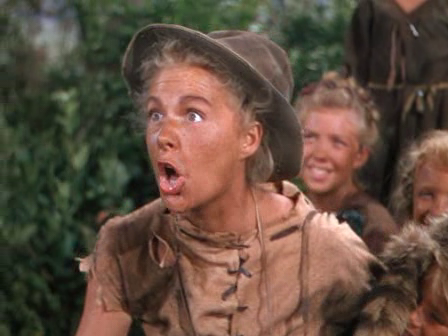
The film starts reasonably well, but takes a drastic turn for the worse the moment Hutton appears, bug-eyed and dressed like one of Peter Pan's lost boys exclaiming her dialogue in a ridiculous accent at an incredible volume, like a ten year old girl doing a Cletus the Slack-Jawed Yokel impression in a wind tunnel. Hutton's Annie is a great marksman who takes up the challenge of dueling the star attraction of Buffalo Bill's traveling Wild West show, Howard Keel's Frank Butler. However, the moment she sees Butler, she's stunned into mouth-agape lust at his beauty. Setting that aside for now, she wins the contest and joins the show. As the months go on, Butler becomes increasingly distressed that Annie's a better shot than he is, which complicates their budding romance. Annie learns to read and be more ladylike (wearing dresses, taking baths). Eventually, Butler leaves her after Annie performs a breathtaking stunt in the show, proving that she is the bigger star. The two are apart for awhile, with Butler having joined a rival show, but come together again in the end after a grudge match Annie throws, allowing Butler to be proclaimed the best sharpshooter in the world. Running alongside the love story plot is Annie's relationship with Sitting Bull, the great Sioux Indian chief who was part of the Buffalo Bill show.
There's three things that offended me most about the film. The first is on the basic level of craft, and by this I don't just mean Hutton's performance. Ethel Merman originated the role on Broadway, and I can see how she would work playing the role this big: Merman was a titanic force of nature, everything she did was huge. Hutton though, seems like she's playing at being big and every note comes out false. Judy Garland was originally going to star in the film, and her unique dramatic intensity would probably have made the film work. I certainly can't imagine her mugging about the way Hutton does. This was pretty much the end of the line for Garland as a major star though. During this time she was replaced in The Barkleys of Broadway and Royal Wedding was released from her MGM contract. At age 28 her film career, aside from a brilliant performance in George Cukor's A Star is Born and an Oscar nominated, supporting role in Judgement at Nuremburg, was essentially over.
Garland wasn't the only person fired from the film though. It was originally directed by Busby Berkeley, who was replaced by Charles Walters, who was then replaced by George Sydney. There's a hint of Berkeley left in the film in the final shot, an arial view of dancing horses forming one of Berkeley's trademark geometric patterns, but for the most part the film feels completely generic. More than that though, there's an incongruity between the apparent attempt at verisimilitude in the directing and the other major elements of the film. Not just Hutton's performance, which is jarringly unnaturalistic next to the supporting performances by Louis Calhern, Keenan Wynn and Howard Keel (none of whom were ever particularly notable for their restraint, this is a side effect of Hutton's egregious broadness), but also in the musical numbers. Some of Irving Berlin's music, especially the film's signature song "There's No Business Like Show Business" indicate an artificiality in the production. They seem to acknowledge that they exist as a part of a musical comedy on a Broadway stage. But in the film, they take place entirely in natural settings. Actors singing about Broadway while on a dusty Indianapolis fairground is just weird, which can be a virtue, but Sydney never develops the incongruity in any way. This should be as playful a film as Vincente Minnelli's The Pirate, where Garland and Gene Kelly's performances, along with the screenplay and Minnelli's direction of the musical numbers create a constant back and forth between fantasy and reality which leads to a fundamental, ecstatic declaration of the joy of performance at the film's climax with Cole Porter's "Be A Clown". I'm not sure exactly whose fault this is, but Sydney did a fine job walking this tightrope in Kiss Me Kate, another musical written by Cole Porter that plays with the conflict between performance and reality. I guess, then, the issue is not so much a matter of Sydney's inadequacy for the material (though Berkeley and Garland might have made something of it) but rather simply the difference between Cole Porter and Irving Berlin.
The next two major issues I have with the film are political in nature, and I'm not sure which is more off-putting. The first is the inherent sexism of the story. Annie is the best sharpshooter in the world, but she can't have the man she loves because his ego demands that he be superior to her in every way. The conflict in the film is her independence, and only when she throws a final match to him, allowing him to be the dominant, superior one can they live happily ever after. The parallels to the post-war issue of men returning home only to find their wives occupying the workforce, and the need therefore to assert them back into the home via a hollow ideology of male superiority are obvious and needn't be lingered on. Suffice it to say that the fact that we are expected to cheer and swoon with romance when Annie finally puts herself in her proper place is nauseating at best.
The racism in the film is only slightly less obvious, and has to do with the way it treats its Indian characters. A couple weeks ago I ranted about the way the documentary These Amazing Shadows used John Ford's The Searchers to show the negative ways in which Hollywood has portrayed Indians throughout the years, despite the fact that The Searchers is itself about that very issue and is very much against it. They should have used Annie Get Your Gun instead. Buffalo Bill's Wild West Show, in reality, had a fairly complex relationship with Indians. On the one hand, the shows itself generally cast the Indians in the role of villain, with big set pieces wherein Indian attacks are fought off by settlers and cavalry. On the other, Bill encouraged the Indians to set up traditional camps, which onlookers could walk through and see the people as they actually lived. (See his wikipedia entry: "He called them "the former foe, present friend, the American", and once said, "Every Indian outbreak that I have ever known has resulted from broken promises and broken treaties by the government."') None of this tension is present in Annie Get Your Gun. The Indians are presented as cartoons on-stage, with Sitting Bull as goofy comic relief, and even worse off-stage. Our first introduction to them has them destroying a train car for no apparent reason (literally, the shot foregrounds an Indian meaninglessly tearing apart a seat cushion with a tomahawk). When they go to France they destroying a pastry shop devouring eclairs left and right. The Indians in the film are children at best, monsters at worst. That the best they come off is in the goofy, casually hideous "I'm an Indian Too" number is saying something. That this film was made the same year as Anthony Mann's defiant Devil's Doorway, two years after John Ford's nuanced yet damning Fort Apache, and was more popular than either is appaling.
Fortunately, all these issues are resolved in an earlier version of the Annie Oakley story, directed by George Stevens and starring Barbara Stanwyck, though it is by no means a perfect film. To begin with, Stanwyck, in my opinion the greatest star in motion picture history, was constitutionally incapable of giving a false performance, one without nuance or intelligence or, most in contrast to Hutton's work, dignity. The contrast between her Annie and Hutton's is apparent from the very start. Hutton literally walks out of a bush, Stanwyck lives in a town, a small town, but one populated by recognizable human characters. She has a mother, a wagon, dresses and washes like any other human and can even read and write. In other words, she's just a small town girl who knows how to shoot, rather than a freak of nature (a competent woman? Egads, how bizarre!) Stanwyck too falls in love at first sight of Buffalo Bill's star sharpshooter (here renamed Toby Walker for some reason, Frank Butler was the name of Oakley's real-life husband), and their first contest proceeds along the same lines as in the musical. But, after seeing how good Annie is, the crowd begins to heckle Toby and Annie misses on purpose to let him save face. Afterwards, she's quite open about her throwing the match (to everyone, including Toby), but Bill hires her anyway and she joins the show. The vital difference here is that as Annie and Toby fall in love, he insists they pretend to be rivals for the sake of showmanship. In reality, he doesn't care one bit that's she's a better shot than he is, in fact, he's quite proud of her skill, but he understands that the audience is more likely to be hooked if he plays the role of the villain. In other words, Toby is a recognizable human being, well-rounded and thoughtful, whereas the musical's Frank Butler is defined only by his one neurosis (along with his prettiness and height). Also, this construction of the plot sets up a tension between reality and performance that the musical could have profitably explored.
Similarly, the Indians fare much better in Annie Oakley than they did in Annie Get Your Gun. Sitting Bull still functions as comic relief, though his cultural misunderstandings are far fewer here and less signs of his own idiocy than the fact that he just doesn't particularly care about white people's sense of propriety. Sitting Bull here is almost a tragic figure, played by Chief Thunderbird, a Cheyenne actor and technical advisor (the musical cast J. Carrol Naish, an Irish-American actor who played General Sheridan that same year in John Ford's Rio Grande) as a man out of step with reality, but determined to survive regardless of how ridiculous or bleak his and his people's situation becomes. This is nowhere more apparent than at the film's climax, where Sitting Bull on his horse looks into the crowd and sees Toby (he and Annie have broken up over a misunderstanding, and he's left the show to run a shooting gallery in New York City). Toby knows he's been spotted and takes off, with Sitting Bull in hot pursuit. He tracks him through the city streets, creating a wonderfully incongruous image of an Indian chief in full regalia stalking through a modern metropolis.
Annie Oakley is a flawed film. The plotting is full of the kinds of conflicts that would easily be resolved if only everyone let everyone else speak. In fact, the big dramatic scene that causes Annie and Toby's breakup is a textbook example of this kind of lazy screenwriting, as Annie is literally interrupted by everyone every time she tries to explain what actually happened. But still, given just how purely awful my experience of Annie Get Your Gun was, watching it was a revelation. I'm not sure if this is always the case with 1950s remakes of 1930s films. Both John Ford's Mogambo and George Cukor's A Star is Born build on their antecedents (Victor Fleming's Red Dust and William Wellman's A Star is Born, respectively) in interesting and thoughtful ways. But the parallel I'm best able to draw between what 1950 did to the 1935 Annie Oakley story is the contrast between the two film versions of Show Boat. The first, by James Whale from 1936 is a nuanced portrait of a racially complex society, with dignified performances from its minority characters (including the electrifying Paul Robeson) which is turned into a much simplified musical starring Howard Keel and directed by George Sydney.


_16.jpg)